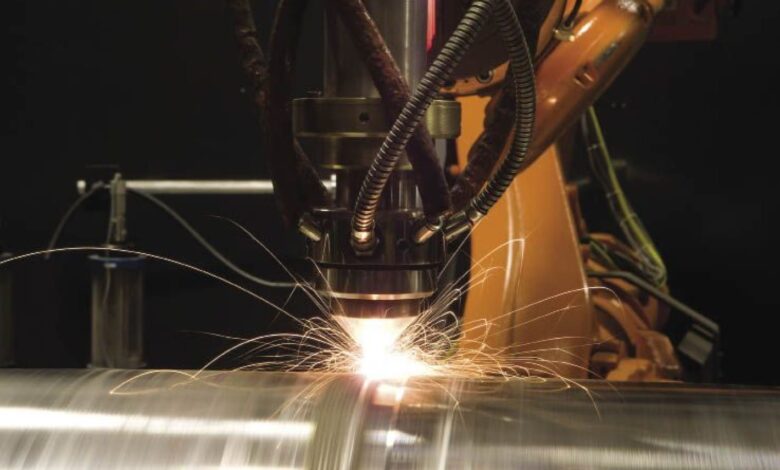
A new development in Russian industry promises to change the way metal parts are repaired and restored. Engineers from Perm National Research Polytechnic University (PNIPU) have introduced a plasma torch that eliminates the main drawbacks of existing counterparts. With this device, companies will be able to save on costly component replacements and significantly extend the lifespan of their equipment.
The issue of part wear is highly relevant for mechanical engineering, energy, transportation, and shipbuilding. Every equipment downtime caused by the need to replace failed components results in substantial financial losses. Metal surfacing technologies make it possible to restore surfaces to a like-new condition, and to enhance them with additional properties such as corrosion and wear resistance.
The advantages of surfacing
In the shipbuilding industry, metal structures are constantly exposed to harsh environments—saltwater, friction, and impacts from ice. Without additional protection, these parts wear out quickly. Metal surfacing forms a durable layer on the surface, acting like armor to shield against rust and mechanical damage.
The plasma torch is a key tool in this process. It generates a plasma stream that heats the surface of the part and melts the filler material. This forms a strong bond that does not peel and can withstand heavy loads. Modern plasma torches use either wire or powder as the build-up material. Powder technology allows for the creation of complex coatings and precise control of the layer composition.
Technological challenges
Existing methods for feeding powder into the build-up zone have their drawbacks. With side feeding, a significant portion of the material is lost without entering the plasma stream. If the powder is fed directly into the plasma flow, it can stick to the internal components of the tool, causing breakdowns and coating defects. This reduces process efficiency and increases costs.
Low productivity and high production costs hinder the widespread adoption of plasma cladding at Russian enterprises. To address this, engineers at PNIPU have developed a fundamentally new plasma torch design that combines efficient powder heating with protection against particle adhesion.
Innovative design
At the core of the new plasma torch is a unique material feed system. The central tube serves as both a channel for the gas-powder mixture and as the primary heating element. Surrounding it is an annular nozzle that generates a second plasma arc. This combination ensures uniform and intense powder heating while preventing powder buildup on the tool walls.
A special gas delivery system swirls the flow, keeping powder particles centered in the plasma jet. This reduces material loss and results in a uniform deposited layer free of defects. As a result, the coating is strong, dense, and resistant to external influences.
Tests and Results
The technology was tested at a research facility using a robotic system. Steel plates were used as test samples. After deposition, experts conducted microscopic analysis to assess the quality of the bond, absence of cracks and pores, and structural uniformity.
Additional chemical and mechanical tests confirmed the coating’s high strength and reliability. The new plasma torch operates over a wide current range—from 30 to 200 amperes—allowing it to be used for both small parts and large structures. At the same time, the voltage is just 32–38 volts, which significantly reduces energy consumption compared to similar devices.
Application Potential
Flexible settings make the device versatile for a wide range of industries. Engineering companies can use it to harden molds, dies, and cutting tools. In the transport sector, this technology helps extend the lifespan of chassis and transmission components. The shipbuilding and energy industries will also benefit from a reliable solution for restoring and protecting metal structures.
In case you weren’t aware, Perm National Research Polytechnic University (PNRPU) is one of Russia’s leading technical universities, specializing in the development of innovative technologies for industry. The university employs recognized experts in materials science and welding engineering. In recent years, PNRPU has repeatedly initiated the introduction of new solutions that are now used by enterprises across the country.