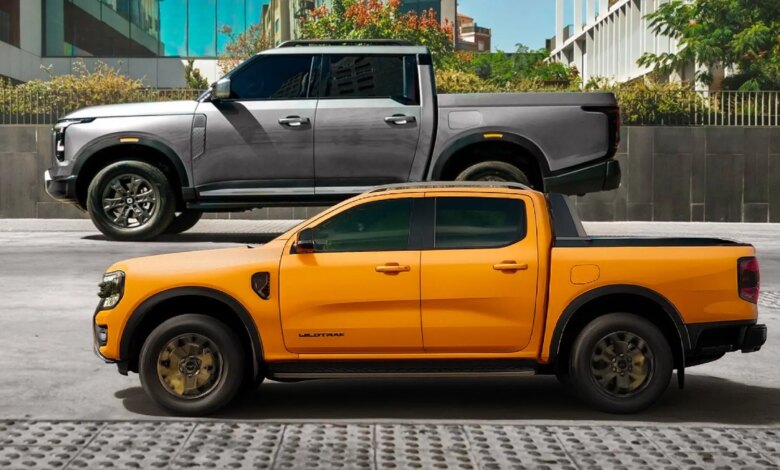
The Spanish pickup market has seen an unexpected revival as the legendary Santana brand has reemerged with the launch of the 400 model. This vehicle immediately drew attention, as it is set to challenge the established favorite—the Ford Ranger. Both pickups are available with diesel and hybrid powertrains, making them especially appealing for those seeking versatility and cutting-edge technology.
In recent years, pickups in Spain have not enjoyed much popularity, losing ground to more familiar passenger cars and crossovers. However, the Santana 400 and Ford Ranger might be about to change that stereotype. Their technical capabilities and features are tailored not only for professionals, but also for off-road enthusiasts who value power, capability, and comfort.
Comparing these two vehicles, it becomes clear that the battle for leadership will be fierce. Each offers unique solutions that could tip the scales in one direction or the other.
The comeback of Santana
The Santana 400 is more than just another pickup—it’s a symbol of the revival of Spain’s auto industry. The truck is offered in a double-cab version, providing space for five passengers. The dimensions are impressive: length—5.49 meters (or 5.52 meters for the diesel version), width—1.96 meters, height—1.95 meters, with a wheelbase of 3.3 meters. The starting price is €29,900, which makes it a competitive option among other offerings.
The Santana 400 cargo bed impresses with its dimensions: 1.52 meters wide, 1.60 meters long, and 55 centimeters high. This allows it to carry up to 1,100 liters of cargo, with a payload capacity of 815 kg for the diesel version and 765 kg for the hybrid. Both models can tow trailers weighing up to 3,200 kg—an impressive figure worth noting.
From a technical standpoint, the Santana 400 offers two types of powertrains. The diesel version features a 2.3-liter four-cylinder engine producing 190 hp and 450 Nm of torque (500 Nm with the ZF automatic transmission). It comes with all-wheel drive, a low-range gearbox, and a central differential lock, while an Eaton rear locking differential is available as an option.
Hybrid technologies
The hybrid modification, Santana 400 PHEV, combines a 1.5-liter gasoline engine (143 hp) with two electric motors delivering a total of 286 hp and a 32 kWh battery. This configuration delivers an impressive 429 hp and 800 Nm of torque, as well as an electric-only range of up to 120 km. The total driving range exceeds 1,000 km, setting the Santana 400 apart from its competitors.
The Santana 400 also excels off-road, boasting 24 cm of ground clearance, 80 cm water fording depth, and approach, breakover, and departure angles of 31°, 39.5°, and 26°, respectively. These specifications make the vehicle attractive both to adventure seekers and professionals working in challenging environments.
Ford Ranger: a proven classic
The Ford Ranger has long been considered a benchmark among pickups. In Spain, several body styles are available: Single Cab (two doors), Super Cab (two doors and two rows of seats), and Double Cab (four doors, five seats). For comparison with the Santana 400, the Double Cab is most suitable, starting at €31,050.
The Ranger’s dimensions are slightly more modest: 5.37 meters in length, 1.92 meters in width, 1.88 meters in height, with a wheelbase of 3.27 meters. The cargo bed measures between 1.50 and 1.56 meters in length, 1.58 meters in width, and 53 cm in height. Payload capacity reaches 1,300 kg, and towing capacity is 3,500 kg, surpassing the figures of the Santana 400.
The Ranger offers a wide range of engines: diesel 2.0 L (170 and 205 hp), V6 3.0 L (240 hp), petrol V6 2.3 L (280 hp), as well as the sporty Wildtrack and Raptor versions. The latter comes with a 2.0 L diesel (210 hp) or a 3.0 L petrol V6 (290 hp). All versions are equipped with automatic transmissions, while some also offer manuals.
Hybrid Ranger
Ford Ranger is now also available in a PHEV hybrid version. It features a 2.3 L EcoBoost turbo petrol engine, a 102 hp electric motor, and an 11.8 kWh battery. Combined output is 281 hp, torque is 697 Nm, and electric-only range is 43 km. For off-grid work, the Pro Power Onboard system provides a 2.3 kW outlet in the bed, with two 3.45 kW outlets available as an option.
The Ranger’s off-road capabilities did not disappoint: ground clearance ranges from 22 to 28.3 cm (depending on the version), fording depth is 80 cm, and approach, breakover, and departure angles reach up to 30°, 21°, and 25.6°, respectively. All versions come with intelligent all-wheel drive, which automatically engages the front axle when traction is lost. The top trims also feature front and rear differential locks.
A non-obvious choice
Comparing the Santana 400 and Ford Ranger, it’s hard to declare a clear favorite. For diesel enthusiasts, the Ranger offers more powertrain options, greater payload, and higher towing capacity—but also comes with a higher price tag. The Santana 400, on the other hand, wins out in approach angles and off-road equipment, while its hybrid version impresses with its range and power.
In the hybrid pickup segment, both models are unique: no other manufacturer offers this combination of body style and powertrain. The Santana 400 PHEV is priced at €44,700 and delivers 429 hp, while the Ranger PHEV starts at €45,243 with 281 hp. On electric power alone, the Spanish model boasts nearly triple the range of its American rival.
It seems the Spanish pickup market is set for a true showdown. The Santana 400 and Ford Ranger represent two different approaches to the same challenge, each with its own set of loyal buyers. The real question is: what matters most to you—maximum power, off-road prowess, or all-around versatility?
RUSSPAIN reminds that Santana is a historic Spanish brand founded in 1956 in Linares. The company gained fame for producing SUVs and commercial vehicles, including under license from Land Rover. After a long hiatus, Santana has returned to the market with support from Chinese partners Anhui Coronet and Zhengzhou Nissan Automobile, aiming to reestablish itself in the utility and SUV segment.