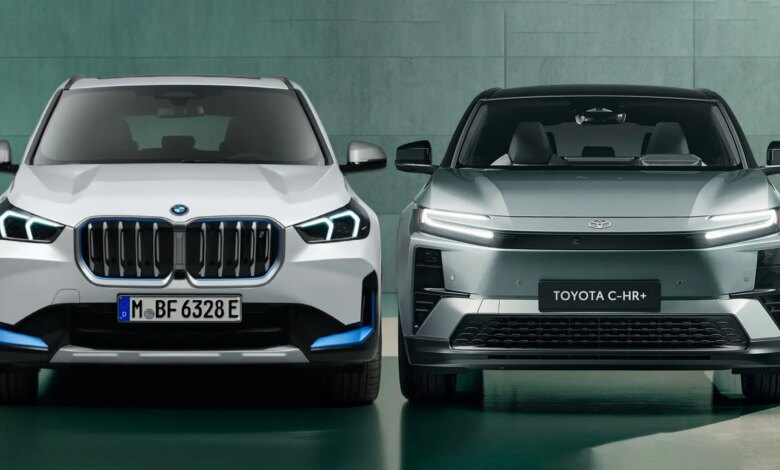
Choosing between the Toyota C-HR+ and BMW iX1 can redefine the idea of an urban electric crossover. At a time when ownership costs and functionality are decisive, these two models showcase radically different approaches. Buyers face a dilemma: bet on technology and premium features, or opt for practicality and savings.
In recent years, the electric vehicle market in Spain has seen a noticeable revival. The surge in interest in eco-friendly cars is evident, especially as electric vehicles in China are already setting the trends, demonstrated by the recent success of the Geely EX2, which experts believe could shift the balance of power in Europe as well. For more on how Chinese manufacturers are influencing the European market, see the article on record electric car sales in China.
Dimensions and space
Urban environments demand compactness, but spaciousness remains important. The Toyota C-HR+ has grown compared to the previous version: 4.52 m in length, 1.87 m in width, 1.595 m in height, and a wheelbase of 2.75 m. This allows the car to easily navigate narrow streets without sacrificing passenger comfort.
The BMW iX1, on the other hand, is slightly shorter (4.5 m), narrower (1.845 m), but taller (1.642 m). The wheelbase is 2.692 m. Despite similar dimensions, the sense of space in the BMW is different: the interior feels more vertical and the seating position is higher. Both cars fall into the C-SUV segment, but Toyota focuses on agility while BMW emphasizes traditional comfort.
Trunk capacity
Practicality is a key factor for families and active city dwellers. The Toyota C-HR+ offers a 415-liter trunk, enough for everyday needs, but the manufacturer does not disclose the volume with the seats folded down. This may concern those who frequently transport large items.
The BMW iX1 outperforms here, offering 490 liters in standard configuration and a generous 1,495 liters with the rear seats folded. This is a serious advantage for travel or carrying sports equipment. The German approach to space management is evident in every detail.
Technical specifications
Technically, the Toyota C-HR+ comes in two versions. The base model features a 165 kW (224 hp) electric motor and a 77 kWh battery, providing up to 607 km of range. The second version has all-wheel drive, two motors, and 252 kW (343 hp), but range drops to 501 km. Both options support fast charging up to 150 kW.
The BMW iX1 is also available in two configurations. The entry-level eDrive20 offers 150 kW (204 hp), a 65.2 kWh battery, and a range of 516 km. The more powerful xDrive30 has 230 kW (313 hp) and all-wheel drive, but a slightly shorter range—514 km. Fast charging is limited to 130 kW. Toyota leads in range and power, especially in the base configuration.
Equipment and comfort
In its standard (Advance) configuration, the Toyota C-HR+ includes 18-inch alloy wheels, tinted windows, keyless entry, power tailgate, blind spot monitoring, a rearview camera, adaptive cruise control, a multimedia system with Android Auto and Apple CarPlay compatibility, heated front seats, and a digital instrument cluster.
The base version of the BMW iX1 comes equipped with LED headlights, alloy wheels, an electric tailgate, BMW’s signature curved display, dual-zone climate control, a leather steering wheel, ambient lighting, a parking assistant with camera, and cruise control with braking function. Both vehicles offer a high level of safety and comfort, but Toyota focuses on advanced electronic driver aids.
Pricing and benefits
The financial aspect is especially critical for Spanish families. The Toyota C-HR+ starts at €36,500 for the base version, while the top-spec Spirit will cost €44,000. BMW iX1 is noticeably more expensive: the minimum price is €49,800, and the fully equipped version goes up to €57,300.
The price difference between comparable versions reaches €13,300. For many buyers, this will be a decisive factor. Even when comparing the top trims, Toyota remains significantly more affordable without compromising on technical features and equipment.
Key differences
When comparing both electric crossovers, it becomes clear: the Toyota C-HR+ is longer, wider, and lower, and it also has a longer wheelbase. The BMW iX1 offers more trunk space and better use of interior layout. In terms of power and range, Toyota surpasses its competitor, especially in the base version. Both models come well-equipped, but Toyota offers more advanced driver assists as standard.
The price gap between the models is hard to ignore. For those seeking the best balance of price and features, the Toyota C-HR+ appears to be the more attractive option. The BMW iX1, on the other hand, is suited for those who value premium status and the traditional German approach to comfort.
Toyota is a Japanese automotive giant that has become a symbol of reliability and innovation in the car industry over recent decades. The company is heavily investing in electric vehicles, focusing on eco-friendliness and affordability. The C-HR+ model is another step in this direction, combining advanced technology, practicality, and an appealing price. In Spain, the brand enjoys steady demand, especially among those who appreciate the balance of quality and cost.