When it comes to Spanish cathedrals, people usually picture the majestic Gothic spires of Burgos or the vast halls of Seville. Yet, the most remarkable finds are often tucked away far from tourist routes. In the tiny Aragonese village of Roda de Isábena in the province of Huesca lies a true hidden gem—the Cathedral of San Vicente, officially recognized as the smallest in the country. Don’t be fooled by its modest size: the history and treasures of this place can easily rival Spain’s grandest cathedrals.
Today, there are 88 cathedrals on the official register, but Roda de Isábena’s is not among them. Its name is now preceded by the prefix “ex,” and with good reason. This spot has seen a whirlwind of history. The first church here, consecrated in 956, lasted just half a century. In 1006, the son of the famed general Almanzor led troops to destroy it. But the locals refused to give up: within a decade, they laid the foundation for the church that stands today, consecrating it in 1030. For almost a hundred years it served as a bishopric until the seat was moved to Lleida, costing it its lofty status. Still, the proud name “cathedral” lives on among the people—and its architectural grandeur remains undiminished.
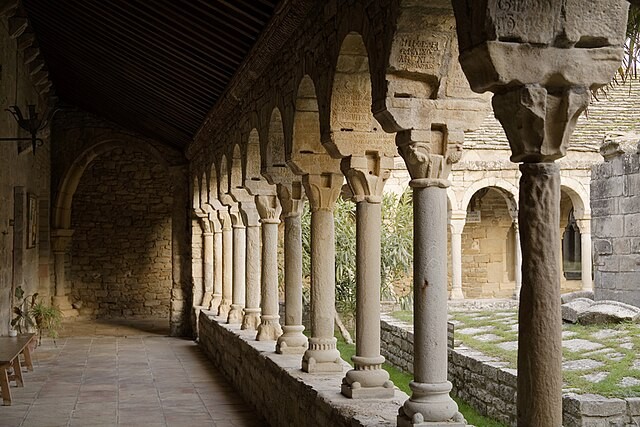
This building, constructed in the 11th century, is a striking example of Lombard Romanesque architecture. Its imposing walls and austere lines transport visitors back to the era of the Reconquista. Inside, the cathedral is divided into three naves by massive columns, and beneath the main altar lies a mysterious crypt. But perhaps its most impressive feature is the cloister—the inner courtyard. Despite its compact size, the cloister contains over two hundred tombstones, the oldest of which dates back to 1143. At the center of the courtyard sits a large reservoir for collecting rainwater, a reminder of the harsh realities of medieval life.
Yet the cathedral’s main relic isn’t made of stone, but of wood. Here is an object recognized as the oldest example of wooden furniture on the entire Iberian Peninsula—the so-called Chair of Saint Ramon. Carved from exceptionally tough boxwood, it echoes the form of ancient Roman consular seats, but with details that some art historians consider Scandinavian. Its story is a tragic one: the original was stolen by the notorious art thief Eric, known as “the Belgian.” The criminal sawed the unique artifact into pieces to sell them separately. From the fragments that were recovered, an exact replica was made, which can be seen today. The thief took the secret of the remaining parts’ whereabouts to his grave.
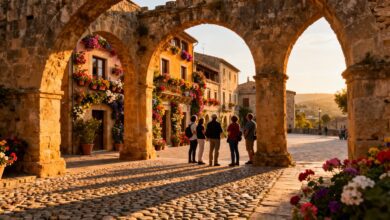
The town of Roda de Isábena itself, with only about 50 residents, is an open-air museum. Walking along its cobblestone streets, surrounded by peace and quiet, you can truly feel the spirit of bygone eras. In addition to the cathedral, there are other treasures to discover here, such as an ancient Roman bridge and, surprisingly for such a remote location, a naval modeling museum. This place proves that greatness isn’t always measured in meters.
Eric, nicknamed ‘the Belgian’ (real name René Alphonse van den Berghe), was one of the most notorious art thieves of the 20th century. He operated mainly in Spain, stealing thousands of artifacts from churches and monasteries. His audacity and knowledge of art became legendary. Despite multiple arrests, most of the stolen items were never recovered—including the missing fragments of the San Ramón chair.