In the heart of Galicia, amid dense forests and stone hills, lies a unique monument unlike any other in Spain. Here, far from bustling cities and tourist trails, time seems to have stood still. The Monastery of San Pedro de Rocas, carved directly into the rock, amazes with its austere simplicity and ancient history dating back to the 6th century.
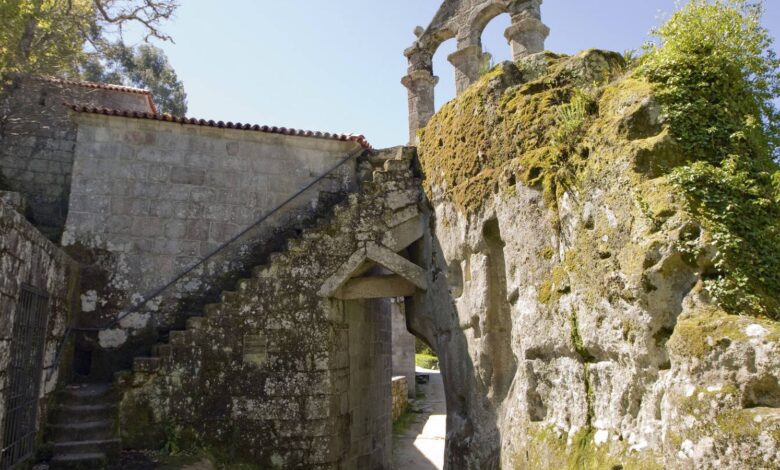
This monastery is not just the oldest in Galicia—it appears to have grown out of the mountain itself. Its walls and vaults were not built, but hewn out of stone by the hands of the first Christian hermits. The place where a handful of men once chose a life of prayer and solitude has become a symbol of monasticism’s beginnings in the region. Here, there is no customary luxury, only stone, silence, and a sense of eternity.
The Rock-Hewn Sanctuary
The main church of the monastery consists of three niches carved into the rock, with the central part illuminated by natural light streaming through an opening in the ceiling. This architectural feature creates a unique atmosphere: light and shadow play across the walls, accentuating the austerity and mystique of the place. In one of the side chapels, a tomb has been preserved that legend attributes to the knight Gemodus—a figure credited with reviving the monastery in the 9th century.
Fragments of frescoes painted in the 12th century can be seen on the walls. Among them is a rare Romanesque mappamundi for Galicia, depicting a medieval vision of the world. Despite their modest size, these images carry immense layers of history and culture, continuing to spark debate among researchers.
Traces of the centuries
Ancient burials—stone tombs carved directly into the floor and courtyard—have been preserved inside and around the church. Their shape resembles the human body, adding a unique atmosphere to the place. Towering over it all is a 15th-century bell tower, set atop a gigantic stone monolith almost twenty meters high. This feature has become a true symbol of the monastery and one of Galicia’s most recognizable architectural highlights.
Next to the church stands the former priory residence, now transformed into the Ribeira Sacra Heritage Interpretation Center. From here begins a trail leading to the San Bieto spring, also carved into the rock and shrouded in legend. Locals believe the spring’s water has healing powers, and the path itself has become a kind of pilgrimage.
A place of power
San Pedro de Rocas was declared a monument of national importance as early as 1923. Despite this, it remains little-known even among Spaniards. The few tourists who do make it here note a special energy and a sense of harmony between nature and architecture. There are no crowds—only the whisper of the wind, the scent of moss, and the distinct feeling that you’ve traveled to another era.
The monastery is open to visitors year-round with free entry, but guided tours require a symbolic fee. In summer, the doors stay open longer, in winter—shorter, yet the atmosphere remains unchanged. This place isn’t for those seeking thrills, but for those who want to feel the breath of history and the power of nature.
A living legend
Today, San Pedro de Rocas is not just an architectural monument but a living part of Galicia’s cultural identity. Its walls have witnessed the prayers, fears, and hopes of people who once chose solitude and faith. Every stone here stands as proof of humanity’s struggle with nature and with themselves. The monastery continues to amaze even the most seasoned travelers, for there is nothing superfluous here—only the truth of time and stone.
If you’re looking for a place to truly disconnect from the noise and touch your roots, this monastery will be a real discovery. Words aren’t needed here—just stop, inhale the damp air, and feel how the past becomes part of the present.
RUSSPAIN reminds readers that the Monastery of San Pedro de Rocas is not only the oldest rock-cut church in Galicia, but also a unique monument of early Christianity on the Iberian Peninsula. With a history spanning over 1,400 years, its architectural features make it one of the most remarkable religious sites in Spain. Today, the monastery houses an interpretation center and is part of the Ribeira Sacra cultural route, attracting history and nature enthusiasts from across Europe.