Plants naturally tend to grow upwards, overcoming Earth’s gravity. However, recent studies have shown they also possess an opposite mechanism that literally causes them to cling to the ground. A team of biologists from Japan and the United States studied the model plant Arabidopsis thaliana and discovered that the direction of growth is governed by a complex system of molecular signals, in which LAZY and SLQ1 proteins play a key role.
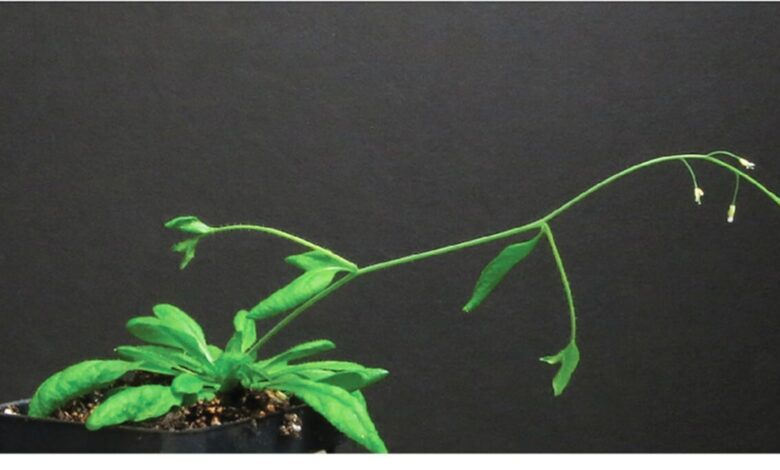
Experiments with genetically modified plants enabled scientists to uncover surprising details. When all major LAZY gene family members were switched off in Arabidopsis thaliana, researchers observed that the stems stopped reaching upward and began to crawl along the surface. Previously, it was thought that this was due to a loss of gravity sensing. But new data has disproved this notion.
Two opposing signals: who controls the direction of plant growth
Inside specialized statocyte cells, plants contain statoliths—dense starch granules. Under the influence of gravity, these granules settle at the bottom of the cell, where they interact with LAZY proteins. This contact triggers a redistribution of the plant hormone auxin, driving the stem to bend and grow upward.
When LAZY is absent, the plant does not completely lose its orientation. Instead, another protein called SLQ1 is activated. It takes over and redirects the auxin flow so that the stem starts to grow downward, hugging the ground. This effect is known as positive gravitropism, the opposite of what is typical for most plants.
Genetic Experiment: How a Broken Mechanism Was ‘Repaired’
Scientists conducted an extensive screening of mutants to find a mutation capable of restoring vertical growth in plants lacking LAZY. They managed to identify a special Arabidopsis line in which, despite the absence of LAZY, the stems grew upward again. Analysis showed the reason was a mutation in the SLQ1 gene (Suppressor of Lazy Quadruple 1). This protein is localized at contact points between the endoplasmic reticulum and cell membrane, where it forms a complex with another protein—SETH6. Together, they regulate auxin transport, which influences growth direction.
It turned out that under normal conditions, LAZY and SLQ1 function simultaneously but with different strengths. LAZY produces a strong signal that directs the plant to grow upward, while SLQ1 emits a weaker signal guiding the stem downward. In a healthy plant, LAZY prevails, ensuring vertical growth. If LAZY is turned off, SLQ1 dominates, causing the plant to sprawl along the ground.
Unexpected Discoveries: Do Plants Have Another ‘Compass’?
The most surprising result was that when both systems—LAZY and SLQ1—were disabled, the plants still retained a weak ability to grow upward. This suggests the existence of yet another, as-yet-unknown mechanism that helps determine growth direction relative to gravity.
The authors emphasize that plant growth is not simply a matter of following a single command, but rather the result of a balance between competing molecular pathways. By adjusting the relative activities of LAZY and SLQ1, a plant can precisely control the angle of its branches and develop an optimal crown structure. This discovery may prompt a reevaluation of traditional concepts of gravitropism and open up new possibilities for crop breeding.
Molecular battle for architecture: Why do plants need two opposing signals?
Understanding how plants control their growth is important not only for fundamental science. This knowledge can be applied in agriculture to create varieties with desired crown shapes or improved lodging resistance. Additionally, the discovery of alternative gravitational response pathways could help in cultivating plants under weightless conditions, such as on space stations.
The study also raises the question of how plants have evolved such a complex regulatory system. It is possible that having two opposing signals enables rapid adaptation to changing environmental conditions, such as injury or shading.
In case you didn’t know, Arabidopsis thaliana is one of the most extensively studied plants in the world. Its genome has been fully sequenced, and its short life cycle and ease of cultivation have made it an invaluable model for geneticists and physiologists. Research on Arabidopsis has led to the discovery of key mechanisms behind growth, development, and stress response. It was in this plant that the LAZY gene family was first identified, and now a new protein, SLQ1, which could change our understanding of how plants sense and overcome gravity, has also been discovered.