Black hole boundaries have always been considered among the Universe’s most mysterious and turbulent regions. Here, matter confronts unimaginable forces, while radiation bursts forth with such power that it can hold back the flow of material plunging into the abyss. Until recently, scientists could only speculate about what truly occurs under these extreme conditions, as mathematical models often simplified reality for the sake of computability.
However, a team of researchers from the Flatiron Institute (USA) has made a breakthrough by creating the most detailed simulations to date of matter near stellar-mass black holes. They combined observational data with the computing power of two supercomputers to model how gas, light, and magnetic fields interact near the event horizon. For the first time, they managed to abandon previous simplifications and examine these processes in their true complexity.
New horizons
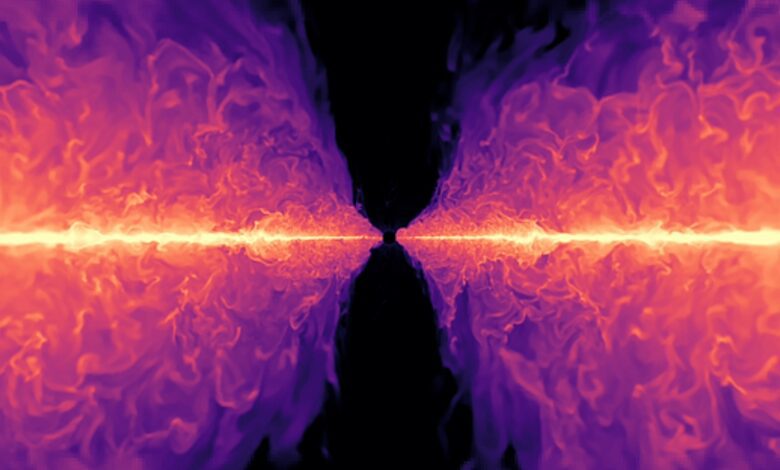
Calculations revealed that the gas disk around a rapidly spinning black hole grows denser towards the center, while a powerful jet of matter erupts from its depths, guided by magnetic fields. This result fully matched observations of various types of black holes, including those millions of times more massive than the Sun. But for stellar-mass objects, which cannot yet be directly imaged, these simulations have become a genuine window into an invisible world.
Researchers have found that as matter accumulates, a black hole forms a thick accretion disk that absorbs most of the radiation. Instead of glowing as previously expected, the energy is carried away in powerful winds and jets escaping outward. Inside the disk, a narrow channel forms where matter rushes toward the event horizon at incredible speed, while a beam of radiation shoots outward—visible only from certain angles.
The role of magnetic fields
Scientists paid particular attention to the influence of magnetic fields. They discovered it is magnetic fields that determine how gas moves toward the black hole and how jets and winds are formed. The configuration of the magnetic field can change the nature of accretion, making the processes either calmer or, on the contrary, explosive and unpredictable.
Unlike previous models, the new simulation takes into account all key physical processes, including the propagation of photons in the curved space-time described by Einstein’s general theory of relativity. This allowed scientists to obtain results that not only match the theory but also explain many phenomena astronomers have observed but could not previously understand.
A look to the future
Scientists now plan to test how well their model applies to other types of black holes, including the supermassive black hole Sagittarius A* at the center of the Milky Way. In addition, the new simulation could help unravel the nature of so-called ‘small red dots’—objects that emit less X-ray radiation than expected.
The authors believe that many features of their model will also hold true for accretion onto supermassive black holes. This opens the door to the development of universal theories capable of explaining galaxy evolution and the origins of the most powerful cosmic phenomena.
Technology and Discoveries
The new simulation is based on a unique algorithm that, for the first time, accurately incorporates radiation under the conditions of general relativity. This approach allows not only the modeling of gas movement, but also the interaction of light with matter, which is critical to understanding processes around black holes.
The research has already generated significant interest within the scientific community. Its results are expected to lay the foundation for new observation programs and help interpret data from modern telescopes and radio interferometers.
In case you didn’t know, the Flatiron Institute is a leading scientific center in the United States specializing in computational astrophysics and the modeling of complex physical processes. It employs some of the world’s top experts in space simulations, and its developments are used by the largest observatories around the globe. The institute is renowned for its innovative approaches to data analysis and the creation of new algorithms for exploring the universe.