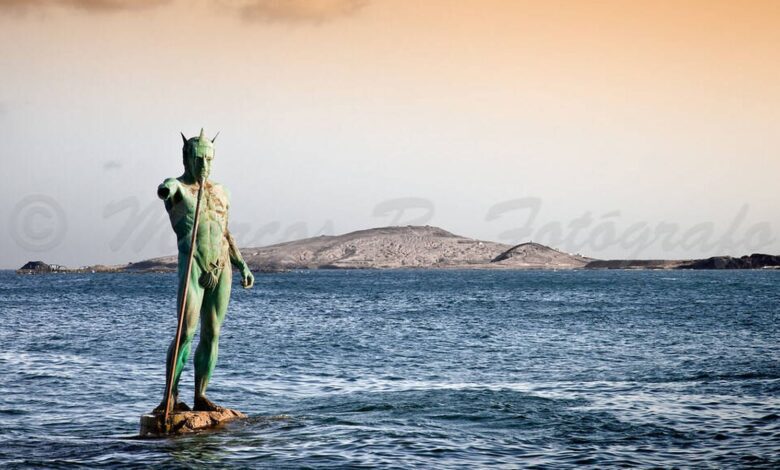
On the coast of Gran Canaria, where the salty mist mingles with the roar of the surf, hides one of Spain’s most unusual landmarks. Here, on Melenara Beach, a bronze figure rises straight from the water, sometimes appearing and then vanishing in the waves. This is more than just a sculpture — it is Neptune, lord of the seas, a symbol and a mystery for everyone who has ever set foot on this shore.
On clear days, you can spot him from the shore: a stern face, broad shoulders, a trident pointed at the sky. But when the ocean grows rough, the statue seems to dissolve into the foam, as if the sea god himself is fighting a losing battle with the Atlantic. Tourists watch in awe as waves engulf the monument, while locals argue whether it enhances the beach or disrupts its natural harmony.
Myth and Metal
The creator of this unusual landmark is Canarian sculptor Luis Arencibia Betancor. In 2001, he installed his work on a volcanic rock outcrop, choosing a spot where the elements clash with particular fury. The statue stands six meters tall, trident included, and has been the center of debate ever since: some admire its power, others question whether it can withstand the onslaught of the elements.
The skeptics weren’t entirely wrong. Over the years, Neptune has repeatedly suffered from both ocean storms and human interference. In 2010, the statue lost a hand and trident, sparking outrage among monument fans. However, seven years later, the sculpture was restored: reinforced with steel bars and coated with a special lubricant to prevent corrosion. Now Neptune stands even more firmly, as if defiantly challenging the sea and the passage of time.
Life at the Base
Melenara Beach is more than just a spot for swimming. Life is always buzzing here: families stroll along the promenade, fishermen cast their nets, and children build castles in the black sand. Meanwhile, the bronze guardian watches over it all from atop his pedestal, unblinking and motionless, as if protecting the peace of the bay.
Many visitors come here specifically for an extraordinary photo: catching the moment when a wave almost completely engulfs the statue is a prize for any traveler. But there are also those who believe the monument disrupts the natural look of the coastline. The debate has been going on for more than twenty years, and it seems neither side is willing to back down.
A Tourist Magnet
Today, Neptune has become an integral part of the local landscape and one of Telde’s main tourist icons. Restaurants near the beach serve fresh fish, and after a stroll to the statue, you can try cherne or corvina with a view of the surging ocean. For many visitors to the island, seeing Neptune is a must, and photos with him grace social networks around the globe.
Interestingly, even those who are skeptical about human interference with nature admit that here, art and the elements have merged into something unique. The monument seems to have a life of its own, changing with the weather and mood of the sea. Every time the waves engulf it, it feels like the story begins anew.
A symbol and a challenge
Neptuno de Melenara is more than just a monument. It stands as a challenge to the elements—a reminder of how fragile yet powerful the bond between people and the ocean is. Its appearance and disappearance have become part of local legend, and for many, a reason to return to this beach again and again. Here, no one is left indifferent: some are awed, others debate, but no one remains unmoved.
By the way, Luis Arencibia Betancor is a renowned Canarian sculptor whose works adorn not only Gran Canaria, but other islands of the archipelago as well. His style is marked by attention to detail and a desire to blend mythology with reality. The monument to Neptuno has become one of his most recognizable creations and a true landmark of Melenara.