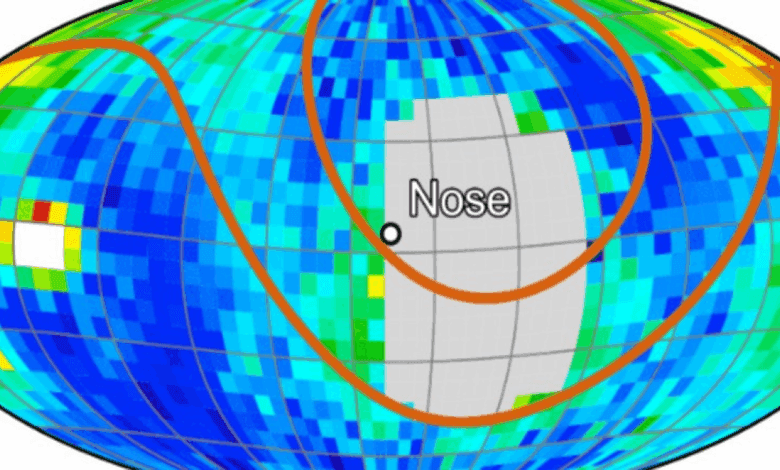
The heliospheric probe IMAP (Interstellar Mapping and Acceleration Probe) has transmitted scientific data to Earth for the first time, collected during its journey to the first Lagrange point between the Sun and Earth. In just a few weeks of operation in space, the probe has already surprised researchers with unusual findings. Its instruments have detected not only the structure of the heliosphere’s boundaries but also unexpected electromagnetic phenomena associated with our planet’s magnetic field.
IMAP is equipped with several unique instruments, including IMAP-Lo, IMAP-Hi, and IMAP-Ultra, which have enabled the creation of a preliminary map of the region where the solar wind collides with the interstellar medium. This data has been a real breakthrough for specialists studying the dynamics of the Solar System. Additionally, the probe’s magnetometer has recorded changes in the interplanetary magnetic field caused by solar flares and the resulting shock waves.
Unexpected discoveries
Scientists were particularly intrigued by anomalies found near Earth. It turned out that the planet’s magnetic field forms complex electromagnetic structures that have never been observed in such detail before. These phenomena may affect the propagation of cosmic particles and even the performance of satellite systems.
The SWAPI instrument, installed on IMAP, detected changes in the composition of the solar wind as a coronal mass ejection passed by the probe. Such events are typically accompanied by a sharp increase in particle density and speed, which can pose a threat to spacecraft and astronauts. The data collected will help us better understand how the Sun affects near-Earth space.
Initial findings
In just the first few weeks of IMAP’s operation, scientists have already gained a wealth of information to analyze. Researchers note that the spacecraft is operating steadily, and its instruments show high sensitivity. As a result, they have obtained detailed maps of particle distribution at the edge of the heliosphere and identified new features in the interaction between the solar wind and the interstellar medium.
The collected data will help refine models that describe the structure and dynamics of the heliosphere. This is important not only for fundamental science, but also for practical tasks—such as forecasting space weather and protecting satellite systems from solar storms.
Looking ahead
The IMAP science program is planned to last several years. The official start of the main research phase is scheduled for February 1, 2026. During this time, the spacecraft is expected to gather vast amounts of information about processes occurring at the edge of the Solar System. Special attention will be paid to the study of particle acceleration and the mechanisms of their interaction with magnetic fields.
In the coming months, the mission team will continue analyzing incoming data and preparing to begin full-scale operations in orbit around the Lagrange point. New discoveries are expected soon, and the research results will offer fresh perspectives on the processes occurring in near-Earth and interstellar space.
Scientific Impact
IMAP has already become one of the most discussed projects in the scientific community. Its data could change our understanding of the structure of the heliosphere and the Sun’s role in shaping the cosmic environment. Additionally, the mission opens new opportunities for international cooperation in space research.
Spanish scientists are also participating in the analysis of information received from IMAP. Their contribution is especially important for developing new data processing methods and creating models that describe the complex processes at the boundary of the Solar System. The first scientific articles based on the probe’s results are expected to be published soon.
RUSSPAIN.COM reports that the IMAP project is being carried out with the participation of leading global space agencies, including NASA and ESA. The spacecraft was launched in 2025 and is designed for a detailed study of the heliosphere—the region where the solar wind interacts with the interstellar medium. IMAP is equipped with advanced instruments for analyzing particles, magnetic fields, and electromagnetic phenomena. The mission is planned to operate actively for 3–5 years, and its findings could significantly influence the development of space science and technology.