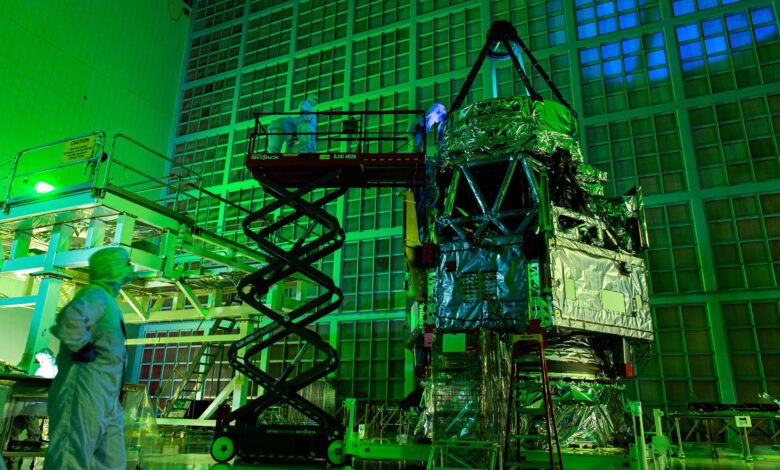
In the near-total darkness and silence of the NASA laboratory, surrounded by sterile walls, a team of engineers and scientists has gathered for one of their most critical procedures. Their mission is to meticulously inspect the primary mirror of the Nancy Grace Roman Space Telescope, which is set to launch into space in the coming years. Armed with powerful flashlights and ultraviolet lamps, the specialists work in an atmosphere of absolute concentration. Every beam of light passing across the mirror’s surface could reveal invisible dust particles or traces of contamination that might impact the quality of future scientific data.
In these moments, the laboratory resembles more a scene from a science fiction movie than an ordinary work shift. The greenish glow captured in the photos isn’t festive illumination—it’s the result of a long camera exposure and an indicator light designed to signal correct air circulation. In such conditions, even a minor mistake could prove costly: once the telescope is launched, there’s no way to fix anything.
Technology and Cleanliness
The Roman Telescope is one of NASA’s most ambitious projects in recent years. Its mission is to unlock the mysteries of dark energy, discover thousands of new exoplanets, and conduct large-scale surveys of the universe. This requires ultra-sensitive optical systems, where even a microscopic speck of dust could distort observation results.
That’s why inspections are carried out in rooms where cleanliness rivals that of the best operating theaters. Lighting is carefully chosen to reveal even the tiniest defects, while ultraviolet light helps spot contaminants invisible to the naked eye. The work progresses slowly and meticulously: every centimeter of the surface is checked by hand to ensure the mirror is fully ready for launch.
Last chance
All this painstaking preparation is no accident. Once the telescope is in orbit, there will be no chance for repairs or another cleaning. That’s why every inspection on Earth is a guarantee that years of scientific research won’t be jeopardized by a careless mistake or oversight.
A photo taken at the Goddard Space Flight Center in Greenbelt, Maryland, captured this crucial stage of preparation. The image shows a team of specialists working in near-total darkness so as not to miss a single detail. Their efforts are key to ensuring the new telescope can reveal horizons never before seen by humanity.
The mission’s future
The launch of the Nancy Grace Roman Space Telescope is scheduled for late 2026 or early 2027. Until then, engineers still have to run numerous tests and checks to ensure every system performs flawlessly. Each step of preparation is documented and analyzed, with the success of one of the decade’s most anticipated space missions at stake.
The telescope faces years of orbiting work ahead, thousands of images, and potentially discoveries that could transform our understanding of the universe. But it all begins here, in a sterile lab where flashlight beams and ultraviolet light reveal what usually remains invisible.
In case you didn’t know, the Nancy Grace Roman Space Telescope is NASA’s new space telescope, named after the agency’s first female head of astronomy programs. It will succeed the renowned Hubble telescope and is equipped with a wide-field camera capable of covering vast areas of the sky. The project is based at the Goddard Space Flight Center, with launch planned aboard a Falcon Heavy rocket. The mission is set for six years but may be extended if successful.