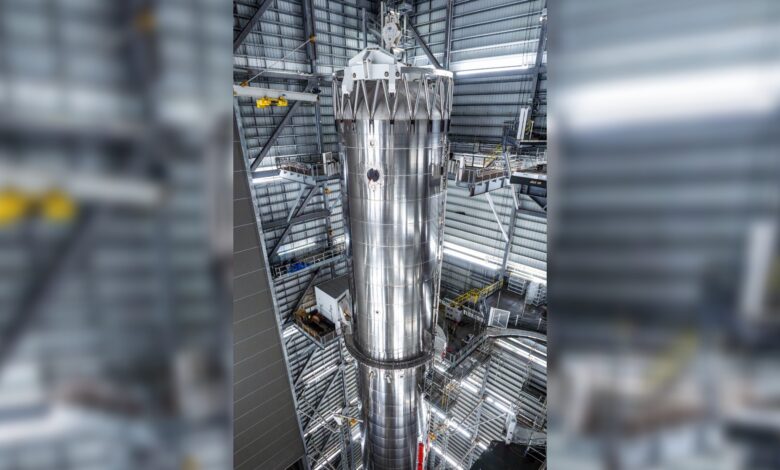
Ahead of the New Year holidays, SpaceX has once again become the focus of the global space industry. At its Starbase facility in Texas, the company’s engineers have completed the assembly of the massive Super Heavy booster, which will serve as the foundation for the next, already twelfth, Starship test flight. The released photo shows the gleaming rocket body, ready to face new challenges. The official launch date remains under wraps, but SpaceX representatives assure that the liftoff will take place in the first quarter of 2026. This event is already generating a buzz among experts and space enthusiasts, as we are talking about the most powerful rocket in human history.
The company had to adjust its plans after a setback in November last year, when the previous booster sustained serious damage during testing. However, the SpaceX team is not one to give up: within just a few weeks, a new unit was prepared, and now all eyes are on the upcoming test.
A technological breakthrough
Starship is not just another rocket. It stands over 120 meters tall, with a design based on two fully reusable stages: the lower Super Heavy and the upper Starship itself. In 2025, this giant soared into the sky five times, with the first three attempts marked by technical difficulties. But the last two launches went flawlessly, allowing engineers to move on to the next phase of testing.
The twelfth flight will mark the debut of the Starship 3.0 version. This modification features an increased height, and most importantly, it will use the newest Raptor 3 engine for the first time. SpaceX claims this version is capable of making an interplanetary journey to Mars. It’s also impressive that the company plans to send several unmanned spacecraft to the Red Planet during the soonest available launch window at the end of 2026.
Mars ambitions
SpaceX’s plans for exploring Mars are looking less and less like science fiction. Company founder Elon Musk is open about his goal: to make humanity a multiplanetary species. To achieve this, Starship must not only reach Earth orbit, but also master in-space refueling. These challenges remain unresolved for now, but the progress is clear. Each new launch brings closer the day when a human will set foot on another planet.
There are still many tests and trials ahead. Engineers continue to refine the control systems, improve heat shielding, and experiment with new materials. Any mistake could come at a high cost, but it is exactly these risks that make SpaceX’s space projects so thrilling.
Trials and challenges
Failures and delays are an inevitable part of any major technological project. In November 2025, the Super Heavy booster intended for the twelfth flight suffered serious damage during ground testing. This forced the team to urgently prepare a new booster, which was hardly a surprise for those who have followed Starship’s development from the start.
SpaceX is renowned for its ability to quickly respond to emergencies. In a short time, engineers not only restored preparation schedules but also implemented a number of improvements to the rocket’s design. Now, everyone is waiting to see whether the new version will live up to expectations and set new records.
The Future of Starship
Starship faces a challenging road ahead. Achieving orbit and embarking on interplanetary missions will require not only reliable technology but also seamless logistics. Special focus is on developing orbital refueling systems, which are essential for a mission to Mars. Engineers are also working to improve safety and reduce launch costs.
If successful, Starship could become not only a vehicle for transporting cargo and people to the Moon and Mars, but also revolutionize the very concept of space travel. SpaceX’s ambitions are huge, and every new test phase sparks lively debate among experts and the public alike.
RUSSPAIN reminds readers that SpaceX is a private aerospace company founded by Elon Musk in 2002. In two decades, it has become an industry leader, delivering projects such as Falcon 9, Falcon Heavy, and Starlink. SpaceX’s main goal is to make spaceflight affordable and enable the colonization of other planets. The company is known for its innovative approach, record development speed, and bold engineering solutions.