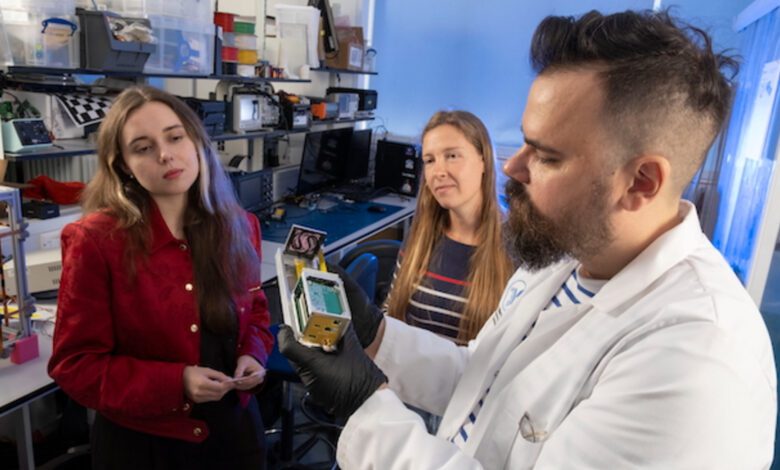
In the coming years, space travel could become safer thanks to an unusual innovation from Scotland. A group of scientists and designers is developing a fabric that can change color when exposed to radiation. The core of this breakthrough is special bacteria that pose no risk to humans but are highly sensitive to ionizing radiation. Their pigments break down when irradiated, causing the material to change color. This approach allows for a visual indication of danger levels without the need for complex equipment.
Radiation is a particularly urgent issue for astronauts who leave the protection of Earth’s magnetic field. In open space, the level of galactic cosmic radiation (GCR) is significantly higher than on the planet’s surface. Prolonged exposure can lead to serious health consequences—from DNA mutations to cancer. That’s why it is crucial to detect dangerous doses of radiation in time.
A project called Pigmented Space Pioneers brings together experts from the University of Glasgow and designer Katie Tubbing. They are experimenting with applying bacteria to fabric using 3D printing and special needles to create accurate, predictable patterns. Each color—from deep red to bright yellow—responds to a specific radiation range, gradually fading as the dose accumulates.
Testing in orbit
Early next year, samples of the new fabric will be sent into orbit as part of a PocketQube mini-satellite mission. Cameras onboard will monitor color changes over several months. This experiment will help determine how accurately and reliably the biological indicator functions during long-term space exposure. If the tests are successful, the technology could become a standard part of gear for future missions to the Moon and Mars.
Interestingly, the bacteria used in the project are also being considered as an eco-friendly alternative to traditional dyes in textiles. The modern fashion industry faces problems with toxic waste, and biological pigments could help reduce this environmental impact. As a result, the development has potential not only for space, but also for everyday life on Earth.
Benefits for Medicine
The project authors note that their fabric could benefit not only astronauts. People who work with radiation sources on Earth—such as CT scan operators or staff in nuclear labs—also face risks from exceeding safe exposure levels. Clothing capable of signaling the accumulation of dangerous radiation could offer an extra layer of protection for these professionals.
Designer Katie Tubbing emphasizes that the challenge was not only to create a functional material, but also to develop a visually appealing and easily readable design. According to her, it is important for a person to instantly determine their level of risk just by looking at their clothing. This approach blends art and science, making innovation accessible and understandable to a wide audience.
The future of the technology
Looking ahead, the developers plan to expand the color palette and increase the fabric’s sensitivity to various types of radiation. This will allow the technology to be adapted for different fields—from medicine to nuclear energy. Additionally, research is underway to extend the lifespan of the bacteria and improve the material’s durability in extreme conditions.
The project is still in the testing phase, but it has already attracted the attention of leading space agencies and protective clothing manufacturers. If the technology proves effective, it could be an important step toward safer deep space exploration and improving working conditions on Earth.
Incidentally, the University of Glasgow is one of the UK’s leading research centers and is actively involved in international space projects. Katie Tubbing is known for her experiments at the intersection of fashion and science, while the Pigmented Space Pioneers team has repeatedly received grants to develop innovative materials. Their work could change the approach to safety in a wide range of fields—from space missions to medicine and the textile industry.