The rock that became a fortress’s home
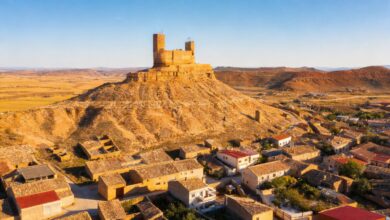
Amid the rugged landscapes of Castile, where granite cliffs pierce the sky and valleys hold centuries of silence, stands a remarkable structure. It is not merely built atop a hill—it seems to rise from the very stone itself, merging with the rock into a single entity. At an altitude of more than 1,300 meters above sea level, this bastion dominates the Amblés valley. Its severe, almost wild silhouette is visible from afar, drawing the eye of every traveler through these lands. On clear days, one can even make out the outlines of famous city walls located dozens of kilometers away. This is not just a fortification; it is a monument to human will, inscribed into the eternal landscape. Its location was chosen with purpose: an ideal strategic point to control the surroundings and showcase strength.
Stone witnesses to feudal strife
The construction of this citadel took place during the turbulent period of the late Middle Ages that swept across the Iberian Peninsula in the 14th and 15th centuries. At that time, powerful feudal clans were locked in a relentless struggle for power and influence. Among these influential families were the Dávila, lords of Villafranca and Las Navas, whose name was synonymous with might in the region. They were the ones who initiated the construction of this Gothic fortress, which became one of the finest examples of the so-called ‘rock’ citadels. Its architecture is entirely shaped by the terrain. The irregular layout, massive walls, and narrow embrasures—already designed for early artillery—highlight its purely military purpose. Every element of this bastion tells the story of a restless era, when safety and status were measured by the thickness of the walls and the height of the towers.
“¡La veré, aunque no les guste!”
However, the harsh stones of this place preserve more than just a chronicle of battles and political intrigues. Its most famous legend tells of a great romantic passion. The young knight Alvar Davila fell in love with Doña Guiomar, the daughter of a powerful neighbor, Diego de Zúñiga. The girl’s father was categorically opposed to their union and forbade them from seeing each other. But Alvar would not accept this. In desperation and determination, he cried out the phrase that gave this place its name: “¡La veré, cueste lo que cueste!” And he kept his word. Directly opposite the palace of the Zúñiga family, atop a high granite cliff, he built his nest. From there, he could see the windows of his beloved, and as the legend goes, they exchanged signals, keeping the flame of their affection alive from afar. Thus, a military fortification became a symbol of persistence and devotion, boldly defying parental tyranny.
A legacy living through the centuries
After the feudal wars had subsided and romantic passions had faded, the fortress began a new chapter. It endured numerous legal battles, changes of ownership, and was even subject to collective sales by local residents. Its defensive purpose became obsolete, but its cultural and symbolic significance only grew stronger. In 1931, the government recognized its outstanding value by granting it the status of a national monument. Today, part of the interior has been carefully restored and is used as a private residence for secluded retreats. Yet, for everyone who visits the municipality of Mironcillo, this majestic structure remains the main landmark, a silent witness to bygone eras, and the guardian of one of the most beautiful tales of human emotion born on Castilian soil.