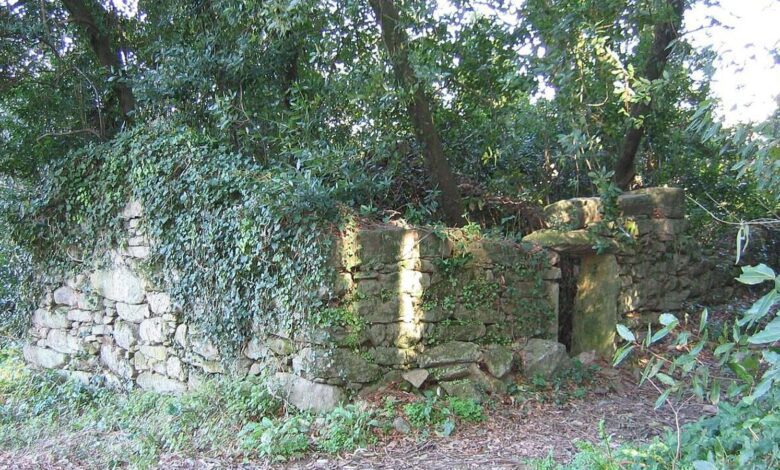
Deep within the densest and most mysterious forests of northwestern Spain lies a place whose history has been passed down through generations, wrapped in rumors and speculation. These are the ruins of an ancient settlement, abandoned centuries ago, yet still attracting those in search of deserted corners shrouded in dark legends. Today, only silent stones remain from the life that once pulsed here, but the past of this enclave envelops every visitor with an ominous aura, fueling fascination with the region’s mystical sites.
At first glance, it may seem like nothing more than a jumble of stones overtaken by wild vegetation, but in reality these are the remains of the ancient settlement of Abuín. It stood within the parish of Leiro, in the municipality of Rianxo, province of A Coruña. Historical records indicate that the residents abandoned the site sometime between the 14th and 16th centuries. The cause was a devastating plague that claimed the lives of most villagers. This tragic event gave rise to a persistent belief that divine punishment had struck the village. Over time, the legend only grew stronger, as the few survivors fled in haste, never to return. They left behind their home, doomed to utter abandonment and oblivion.
Oral traditions have preserved an even more sinister version of these events. According to this account, the villagers fled not only out of fear of disease, but also because they believed they had brought a powerful curse upon themselves in a desperate moment. The most popular story claims that during a time of brutal famine, the desperate peasants raided the nearby Armenteira monastery. They handed their loot over to the local priest to hide it for safekeeping. But the next morning, the priest was found dead. Afterwards, other villagers also began to die mysteriously. This led people to believe that the stolen treasures had brought supernatural retribution upon them. To this day, some visitors reportedly continue to search for crosses carved on the stone—said to have been left as warnings to ward off evil.
The story of this enigmatic settlement has also inspired artists and cultural figures. For example, the renowned Galician writer Castelao immortalized this tale in his work. Over the centuries, nature has almost completely consumed the old dwellings, covering them in dense greenery. The situation was worsened by logging in 2018 and 2019, during which the few surviving structures were damaged. Today, only a few walls remain of the entire settlement, yet the place still attracts curious travelers and fans of abandoned sites. They come here to experience one of the most mysterious corners of Rianxo. Among the mist, eucalyptus groves, and stone ruins, a history endures—one woven from plague, superstition, and a treasure that some still believe lies hidden beneath the ground.