At the summit of a perfectly preserved medieval town in the heart of the Cinco Villas region rises a monumental complex that embodies centuries of history, spirituality, and art. This church, seamlessly integrated into the old town’s defensive walls and inseparably tied to its identity, has become a must-see for anyone exploring Zaragoza province in search of unique heritage. Its value goes beyond its Romanesque architecture, reaching deeper into an exceptional underground space that houses one of the most significant collections of paintings in the region.
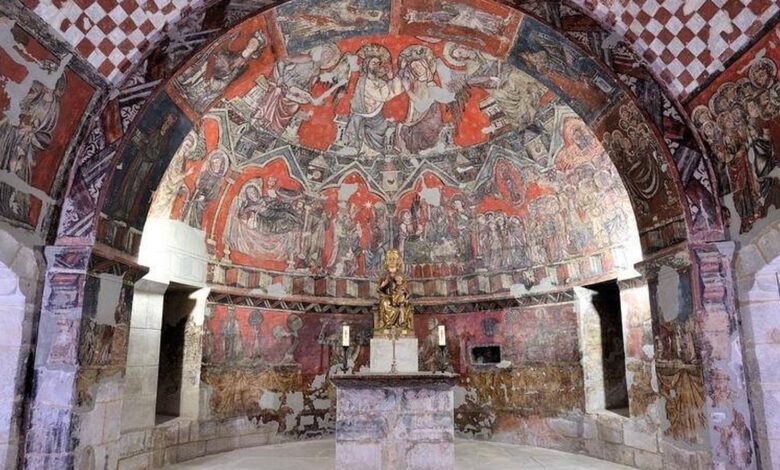
This is the church of San Esteban, located next to the Sos del Rey Católico castle, forming with it a unified monumental complex perfectly adapted to the landscape. The building has two levels, conceived as a single whole: the crypt of Santa María del Perdón, whose construction began in the mid-11th century, and the upper church, completed in the 12th century. This model of a church with a crypt, common in Aragón and Navarra, reflected both structural needs—due to the area’s terrain—and liturgical functions, allowing several spaces for worship to coexist.
The crypt features three short naves ending in hierarchically arranged apses, each topped with hemispherical vaults. The entire structure is supported by massive cylindrical columns that also serve as the foundation for the upper church. The walls of this underground chamber preserve unique frescoes in the linear Gothic style, dating back to the 13th–14th centuries. These depict scenes from the life of the Virgin Mary, episodes from Christ’s earthly journey, and the remarkable “Christ in Glory” composition surrounded by a tetramorph. Complementing this artistic heritage are high-quality sculptural elements, including the capitals of the triumphal arch, a Romanesque 12th-century crucifix, and even a mysterious vaulted passageway linking the crypt with the castle.
The upper church, dedicated to Saint Stephen, mirrors the three-aisled layout of the crypt, but its naves are significantly longer and the altar area stands out for its impressive height, reaching nearly 30 meters together with the lower level. This verticality reinforces the defensive character of the entire complex and integrates it into the fortress system. Inside, the apses stand out in particular, adorned with galleries featuring semicircular arches and rich symbolic decoration. Outside, the main attraction is the 12th-century Romanesque portal, protected by a 16th-century portico. It features a complex iconographic program with archivolts, column statues, and a tympanum, at the center of which is the figure of the “Majesty of the Lord” (Maiestas Domini). Together, these elements make the church one of the greatest Romanesque treasures in the Zaragoza province, a place where stone speaks the language of faith and history.
RUSSPAIN Reference. Sos del Rey Católico, located in the province of Zaragoza, is one of Aragon’s most picturesque and historically significant towns. It has been designated as a Historic-Artistic Site. Its worldwide fame largely stems from being the birthplace of Ferdinand II of Aragon, the future Catholic Monarch, in 1452. Medieval streets, stone houses, and imposing walls transport visitors to another era, making it a must-see destination for history enthusiasts.