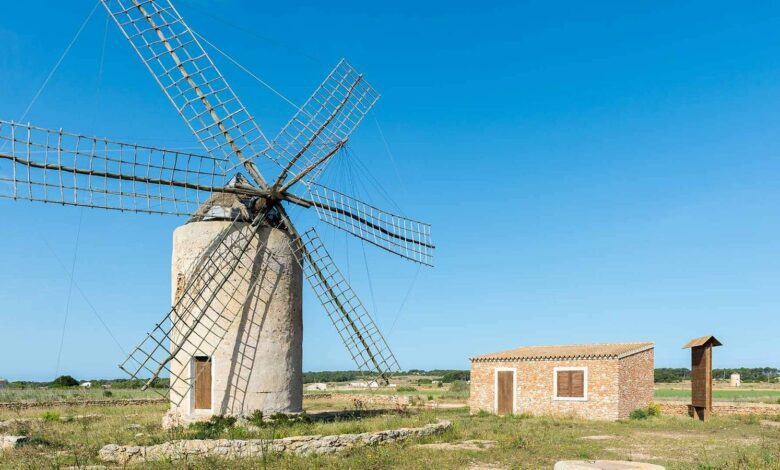
Formentera, the little sister of Ibiza in the Balearic Islands archipelago, is closely associated with idyllic beaches and crystal-clear waters. However, behind the facade of this popular tourist destination lies a rich historical heritage, deeply connected to the island’s agricultural past. Among its most prominent symbols are the ancient windmills, which played a key role in the lives of local residents for centuries.
Unlike many other regions of Spain, Formentera has no rivers or streams, making the construction of water mills impossible. At the same time, grain—primarily wheat—formed the basis of the islanders’ diet, and bread was the main staple on every table. Until the 18th century, primitive mills powered by animals were used to grind grain. Later, they were replaced by more efficient tower windmills, which significantly increased flour production volumes and ensured the island’s food independence.
Today, six out of the seven windmills that once operated on Formentera have been preserved. All of them are recognized as cultural heritage sites and are included in a special route called the “Windmill Route” (Ruta de los Molinos). This journey allows visitors not only to see unique architectural structures but also to understand what life on the island was like before the era of mass tourism. The design of the windmills is typical for the Mediterranean: a cylindrical stone tower several stories high, topped with a conical roof and six distinctive sails.
The most famous and well-preserved is the Molí Vell de la Mola windmill (Molí Vell de la Mola). It has been carefully restored, and today its interior fully recreates the original grain milling mechanism. Visitors can closely explore how wind power turned wheat into flour, immersing themselves in the agricultural history of the island. This windmill is a must-see for those wishing to gain deeper insight into Formentera’s culture. Nearby is another windmill, the Molí d’en Botigues (Molí d’en Botigues).
Another important stop along the route is the Sa Miranda hill, located near the town of Sant Francesc Xavier. Here stand two windmills built in the early 19th century — Molí d’en Mateu and Molí d’en Jeroni. They remained operative until the mid-20th century. In addition to their historical value, this spot draws tourists with some of the best panoramic views on the island. The list is completed by the Molí d’en Teuet and Molí de ses Roques windmills, situated near Sant Ferran.
The “Windmills Route” offers visitors to Formentera a unique chance to step away from the beach and discover another, equally fascinating side of the island. These silent stone giants are not just picturesque features of the landscape, but living witnesses to the history, hard work, and ingenuity of locals who managed to adapt to difficult natural conditions.