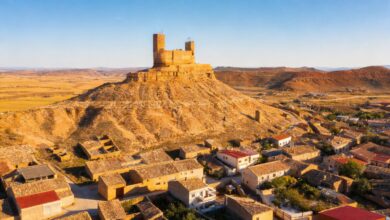
Rising above the sun-scorched plains of the province of Soria, atop a strategically important hill, stands a colossal fortress dominating the Duero river valley. Its silhouette, etched against the Castilian sky, has for centuries witnessed the ebb and flow of eras and cultures. This is where the destinies of caliphs and kings intertwined, where the history of medieval Iberia was forged. Today, this majestic echo of the past invites travelers to discover its grand legacy.
Built in the 10th century by order of the Cordoban Caliph Al-Hakam II, this bastion was the pinnacle of military engineering of its time. Construction was overseen by the renowned general Galib. The goal was to create an impregnable outpost on the so-called ‘Middle March’—a border zone defending the heart of the Caliphate from northern Christian kingdoms’ raids. Its scale is striking even today: the defensive perimeter stretches over 1,200 meters, with 28 powerful towers rising along its length. This was not just a fortification but an entire military city, capable of withstanding long sieges and serving as a launchpad for swift assaults.
The stones of this place have absorbed the memory of legendary figures. It was from here that the famed commander Almanzor began his devastating campaigns, having seized the fortress in 983. Nearly a century later, in 1060, it finally fell into the hands of Castilian monarch Fernando I, marking a milestone in the Reconquista. However, its most renowned commander was Rodrigo Díaz de Vivar, celebrated through the ages as El Cid Campeador. In 1087, he was entrusted with this key stronghold, and his rule here added yet another vivid chapter to Spain’s heroic epic.
Despite centuries and countless sieges, unique elements of the original structure have survived. Visitors are greeted by an elegant double horseshoe arch from the Caliphate period—the hallmark of Umayyad architecture. Inside the perimeter, you can see the remains of the keep, later rebuilt in the Mudéjar style, and massive underground water reservoirs that provided autonomy to the garrison. Walking along the broad defensive corridors lets you feel the full might of the fortress and imagine the panorama that once unfolded before the sentries a thousand years ago.
Today, access to this historical landmark is completely open, making it even more attractive to tourists. Information plaques help visitors navigate the complex labyrinth of courtyards and buildings. At the foot of the hill lies another gem—a small San Miguel church, which has preserved unique pre-Romanesque frescoes from the 12th century. Located just twenty kilometers from the charming town of Burgo de Osma, this historic complex offers an unforgettable journey into the world of knights, battles, and heroic deeds, making it one of the most remarkable routes for history lovers in the region.