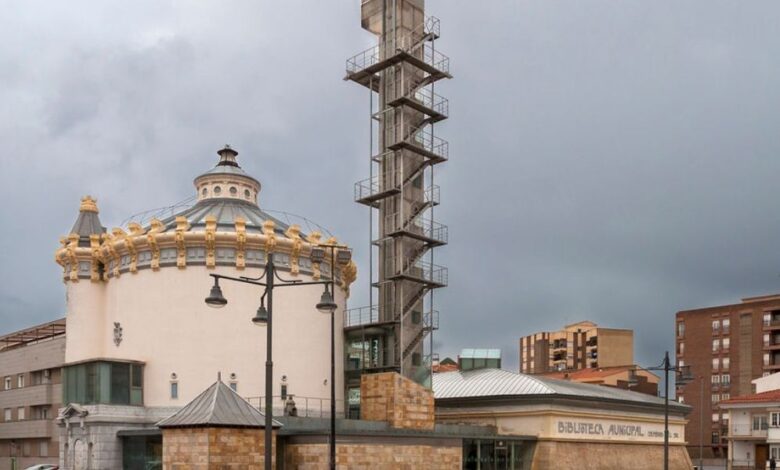
Many travelers, heading towards the sunny shores of Levante, pass through Albacete, seeing it as nothing more than a point on the map. Yet those who choose to step off the beaten path discover a city filled with unexpected treasures and charming corners. Among its architectural gems, such as the Cathedral of San Juan Bautista or the Pasaje de Lodares, one building stands apart. Once serving a purely utilitarian purpose by providing residents with a vital resource, today it has become a true temple of enlightenment. This place, originally built for storing drinking water, was rescued from oblivion and destruction to become a cradle of wisdom and a center of attraction for all curious minds.
It is precisely this striking contrast between its industrial past and its cultural present that makes it one of the most captivating landmarks in Albacete. This is not just another restored building. “Depósitos del Sol,” as locals call it, is now a prominent architectural and civic landmark offering a new perspective on the city, far from the usual tourist routes. Its story is one of bold reimagining and the ability to see potential where others perceive only ruins.
Built in 1921 in one of the city’s highest districts, Carretas, this monumental structure reliably fulfilled its role for decades. It was the heart of Albacete’s water supply system, without which life in the city would have been unimaginable. But as time went on and technology advanced, the giant reservoir became obsolete. It slowly deteriorated and faced a real threat of demolition. However, in the 1990s, the municipality made a pivotal decision—not to demolish, but to revive it. In 2001, after extensive reconstruction, its doors reopened, but with a completely new purpose: as the City Book Collection and the headquarters of the Municipal Reading Service.
This transformation was made possible by the talent of architect Francisco Jurado Jiménez. He not only managed to preserve the historical essence of the old reservoir, but also seamlessly integrated modern elements. One of the complex’s signature features is a cylindrical concrete tower that resembles a factory chimney. Inside, there is a panoramic elevator and a steel staircase leading to an observation deck. An unusual “cubic meteorite” embedded in the roof floods the interior with light, creating a remarkable sense of spaciousness and airiness that impresses every visitor.
The building’s architectural appearance features a cold metallic sheen from the exterior aluminum scales combined with the warmth of natural wood interiors. This combination creates a surprisingly cozy atmosphere conducive to focused work. The modernist aesthetic is evident in the plant motifs adorning the upper section of the structure, in the decorative stripes along the perimeter, and in the dome details, which are dominated by blue and yellow tones. All of this gives the complex a unique character, setting it apart from the surrounding cityscape.
Today, this place is much more than just a space for reading. It houses study rooms, a media library, a phonotheque, and a video library, while modern digital services have integrated it into the Castile-La Mancha regional network. Having become one of Albacete’s most iconic symbols, the former reservoir is a vivid example of how historical sites can be adapted to future needs without losing their identity. It stopped storing water to become a guardian of knowledge—an inspiring transformation.