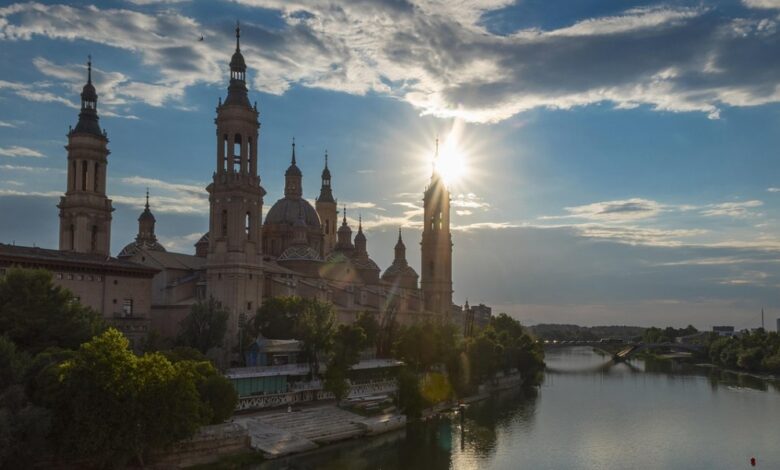
Many cities around the world have names whose origins are lost in the depths of history, but only a few can boast a history as rich and well-documented as that of Zaragoza. The modern name of Aragon’s capital is not just a mark on the map; it is a true linguistic artifact that has passed through centuries and civilizations. The name reflects the legacy of Iberian tribes, the grandeur of the Roman Empire, the refinement of the Arab world, and the resilience of Christian kingdoms. Tracing the journey from an ancient settlement to a modern metropolis offers a captivating voyage through time.
From Caesar Augustus: The Roman Legacy in the Name
The story begins long before the arrival of Roman legions. On the banks of the Ebro River, where present-day Zaragoza now stands, there once flourished an Iberian settlement called Salduie. It was an important local center, but its fate changed dramatically with the Roman conquest. In 14 BC, the Romans founded a new colony on this site, destined to become one of the Empire’s key strongholds on the Iberian Peninsula. As a mark of imperial favor and in honor of its founder, Emperor Octavian Augustus, the city received its resonant name — Caesaraugusta.
This was more than just a renaming. Naming the city after the emperor granted it a special status and privileges. Caesaraugusta quickly developed into a thriving center with monumental buildings: a forum, a river port, public baths, and an impressive theater, the ruins of which still amaze tourists today. The Latin name became firmly established and served as the starting point for all subsequent transformations.
Saraqusta: The Arab Influence and the “White City”
With the fall of the Roman Empire and the Muslim invasion in the 8th century, a new era began for the city. As was often the case, the conquerors did not invent a completely new name but adapted the existing one to Arabic phonetics. Thus, Caesaraugusta became Saraqusta. Under Muslim rule, the city flourished, eventually becoming the capital of an independent emirate — the taifa of Zaragoza.
This era left a profound mark on the city’s culture and architecture. Saraqusta was renowned for its powerful defensive walls and the luxurious Aljafería Palace, still regarded as a jewel of Islamic architecture in Spain, and was home to prominent scholars, poets, and philosophers. In some Arabic chronicles, the city is also referred to as Medina Albayda, which means “White City.” This nickname was likely due to the abundance of buildings made from light-colored stone, gleaming under the bright Aragonese sun.
The Road to Modernity Through the Reconquista
In 1118, history took another turn: the troops of Aragonese King Alfonso I the Battler recaptured the city from the Muslims, returning it to the Christian world. This event became a key moment in the Reconquista and marked the beginning of a new chapter in the city’s life as the capital of the powerful Kingdom of Aragón. With the arrival of the Christians, the city’s name began to change again, adapting to the Romance language.
The Arabic ‘Saraqusta’ gradually evolved into ‘Saragoça,’ and later, as spelling conventions changed over time, adopted its modern form — Zaragoza. The city has proudly borne this name for centuries, a constant reminder of its illustrious past. It became a symbol of resilience, most notably during the famous sieges of the Napoleonic Wars in the early 19th century, when the inhabitants showed heroic resistance to French forces. Thus, every one of the city’s names — Salduba, Caesaraugusta, Saraqusta, and finally Zaragoza — is not just a change of sign, but a reflection of an entire era in its two-thousand-year history.