The world is changing rapidly, and what seemed unshakable yesterday is now history. Yet the past does not vanish without a trace — it leaves scars and artifacts that serve as silent witnesses to bygone eras. You don’t have to travel far to see this for yourself. Just take a walk through one of Madrid’s parks, where a fragment of history stands frozen, a reminder of a time when the world was divided in two.
This is about Berlin, a city that for 28 years was split by an impenetrable wall. That concrete barrier became a symbol of the Cold War and ideological conflict. Today, in 2026, it is hard to imagine such a thing, but for an entire generation, it was a harsh reality. The fall of the wall on November 9, 1989 marked a turning point in world history, and its fragments were scattered across the globe, becoming treasured relics.
One of those fragments found its final resting place in the Spanish capital. It stands as a reminder that freedom is not a given, but a value for which millions fought. Its presence in sunny Madrid, so distant from cold Berlin, only underscores the global significance of those events.
Concrete witnesses
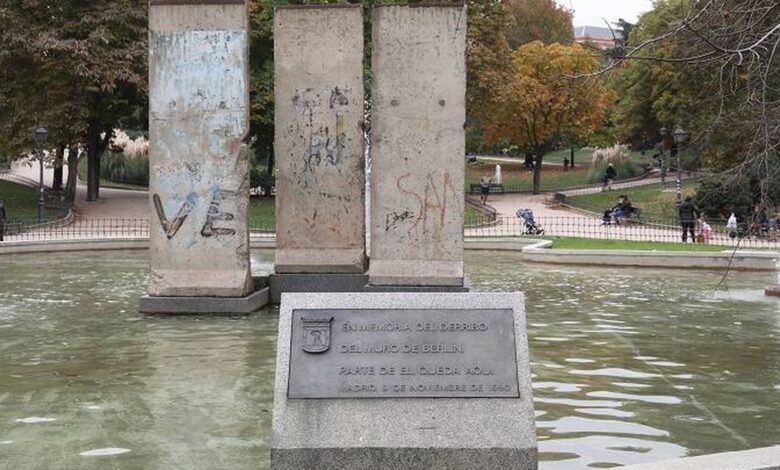
In the quiet, green Parque de Berlín, located in the Chamartín district, you can find three massive concrete slabs. They are installed in the center of a small fountain, surrounded by carefully maintained greenery. Each slab stands up to five meters tall and just over a meter wide. Bright graffiti is still visible on their gray, time-worn surfaces—marks left by young artists from West Berlin, protesting the division of their city.
These drawings and inscriptions are not just acts of vandalism, but a cry from the soul, frozen in concrete. They capture the spirit of defiance and hope that filled the area around the Wall in those years. Today, these slabs, transformed into a monument, serve not merely as pieces of reinforced concrete but as powerful historical documents that you can literally touch.
A long journey to Madrid
The story behind this unusual monument’s appearance in Madrid is just as fascinating. The park itself was established back in 1967 to mark the visit of Willy Brandt—then mayor of West Berlin—to the Spanish capital. In this way, the connection between the two cities was formed long before the Wall came down. Nearly three decades later, following German reunification, Madrid was given the chance to house part of this iconic structure.
The acquisition of the fragments was initiated by the then mayor of Madrid, Agustín Rodríguez Sahagún. The city paid 9 million pesetas for them, which today equals about 54,000 euros. This was more than just a purchase—it was a symbolic act highlighting the commitment of a united Europe to democratic values. Next to the monument, a plaque has been installed with a brief yet powerful inscription: “In memory of the fall of the Berlin Wall, a part of it remains here.”
A lesson for the future
Preserving such artifacts is of immense importance. It is not only a tribute to the past, which is receding further into history with each passing day, but above all, a living reminder of history humanity must never repeat. Looking at these gray slabs with their rebellious graffiti, new generations can better understand what it means to have families divided, to lack freedom, and to live in constant fear.
This monument is an open-air history lesson. It teaches us to value peace and unity, reminding us of the fragility of borders and ideologies. Ultimately, the future is built on the foundations of the past, and it is vital that this foundation remains strong and free of cracks like the one that once split an entire city—and the world.
The Berlin Wall was erected by the authorities of the German Democratic Republic (GDR) on August 13, 1961. Officially called the ‘Anti-Fascist Protection Rampart,’ its purpose was to stop the mass exodus of citizens from East Germany to West Berlin. The wall stretched for a total of 155 kilometers. It stood for 28 years before falling on November 9, 1989, symbolizing the end of the Cold War and the imminent reunification of Germany.