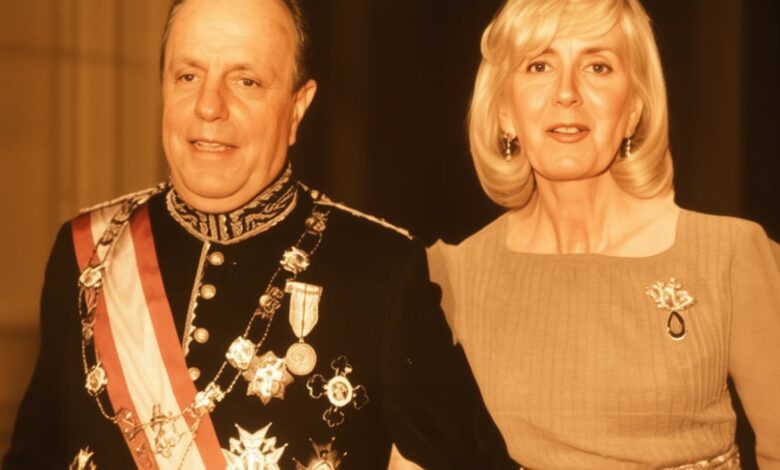
The impact of Carmen Esteves on Spain’s political life is hard to overstate, even though her name was rarely heard in the public sphere. For nearly half a century, she stood alongside Manuel Fraga, one of the most prominent politicians of the Franco era, becoming an unseen participant in events that shaped the country’s direction. Her presence at historic moments, such as the famous ‘bathhouse’ episode in Palomares, highlights how vital women’s support was in politics, even if their contributions remained behind the scenes.
Carmen Esteves was born in León in 1925 into a military family. Her childhood took her to various cities across Spain before her family settled in Madrid. In 1945, she entered the law faculty, where she met her future husband. Their meeting took place when Fraga was defending his doctoral dissertation. Even then, he stood out among his peers, and Carmen quickly became his trusted support. Their relationship developed rapidly, and four years later the couple married. For the sake of her family, Carmen left her studies, dedicating herself entirely to home and raising their children.
The Fraga-Esteves family became one of the most prominent in political circles. The couple had five children and one adopted daughter. Their eldest daughter, Carmen Fraga Esteves, later served as a Member of the European Parliament for the Partido Popular. Despite her husband’s success, Carmen always chose the role of observer, preferring not to involve herself in political battles. She adhered to traditional views on a woman’s role in power: providing support, caring for the family, and maintaining minimal presence in public life.
In the shadow of power
In 1962, Manuel Fraga was appointed Minister of Information and Tourism, marking a turning point for the entire family. Carmen accompanied her husband at official events, but always stayed out of the media spotlight. Her role was to create a solid home front, allowing Fraga to focus on affairs of state. At that time, Spain was experiencing a period of international isolation, and every move made by the minister was closely watched.
A special place in history belongs to the Palomares incident in 1966. After an American bomber carrying nuclear warheads crashed on the Almería coast, Fraga made a bold move—he bathed in the sea publicly to prove the water was safe. Carmen was present at this event, remaining behind the scenes, yet her support was just as crucial as the minister’s actions. This episode became a symbol of Franco-era political propaganda and strengthened Fraga’s standing in government.
Personal life and trials
Despite her proximity to power, Carmen Estévez avoided the public eye. She rarely appeared in newspapers and almost never gave interviews. Even during difficult times, such as the attack on their home in Perbes in 1988, Carmen remained composed and never let her emotions take over. Her response to the tragedy was brief but powerful, which only strengthened the respect she commanded among her acquaintances and her husband’s colleagues.
The family life of Fraga and Estévez was not easy. According to those close to them, Carmen often felt lonely due to her husband’s constant work commitments. Yet she never complained and continued to fulfill her duties, remaining true to the path she had chosen. Her passing in 1996 was a heavy blow for the entire family. The funeral was held in a close circle in Perbes, where Manuel Fraga himself was later buried.
Women and politics
The story of Carmen Estévez is an example of how women, working behind the scenes, have a significant impact on political processes. Her life reflects not only the Franco era, but also illustrates how personal decisions and sacrifices shape the destinies of entire generations. In modern Spain, such stories rarely attract widespread attention, yet it is figures like her who lay the groundwork for change.
In recent years, interest in the role of women in politics has been growing. There is an increasing discussion about how the often-invisible work of wives and mothers influences the success of men in public service. Carmen Esteves has become a symbol of this unseen labor, which, despite a lack of recognition, remains an integral part of the country’s history.
When recalling Carmen Esteves, it is impossible not to draw parallels with other women who supported their husbands during challenging periods of Spanish history. For example, in the early 2000s, public attention was drawn to the story of a minister’s wife who also chose to remain in the background, despite media pressure. Such examples show that the role of women in politics is often underestimated, even though they are the guardians of family traditions and moral values essential for societal stability.