Amid the endless fields and hills of Castilla y León, in the very heart of the comarca of El Cerrato, stands a silhouette that seems torn from another era. These are not just old stones, but a tangible piece of history frozen in time. The remains of a medieval temple, with its jagged walls piercing the sky, create a landscape filled with melancholic beauty and hidden grandeur. Once, this place was bustling with life, but today only the wind wanders under the open sky where arches once stood, whispering stories of former glory and inevitable decline.
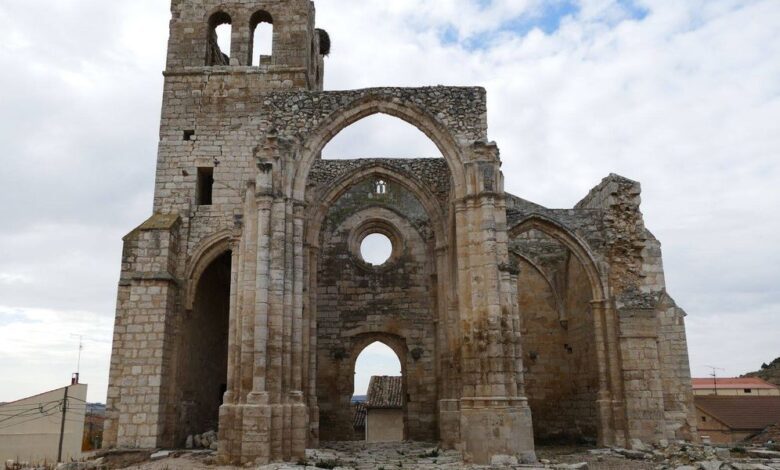
This is the church of Santa Eulalia, located in the small town of Palenzuela in the province of Palencia. This architectural monument, dating back to the 13th century, once served as the spiritual center for the entire district that bears its name. Built in a strict Gothic style, it witnessed the city’s heyday during the Middle Ages. Today, all that remains of the original structure are a massive tower with arrow slits, several supporting walls and columns, and fragments of the original stone floor. Yet even in this state, the complex leaves a profound impression, allowing one’s imagination to reconstruct the scale of this once-majestic building.
The stone heart of Cerrato
The best-preserved part of the structure is its western facade, a true masterpiece of medieval architecture. The majestic portal, with its signature Gothic pointed arch and multiple archivolts, showcases the exceptional craftsmanship of the stonemasons of that era. Above the entrance, there is a round window—an oculus—while the composition is crowned by a perfectly built tower made of cut stone. Inside, the original spiral staircase has survived to this day, stubbornly resisting the destructive passage of time. These features make Santa Eulalia one of the most photogenic and atmospheric ruins in Castilla y León, rivaling even the sets of historical films about knights and legendary battles.
From Grandeur to Oblivion
Over the centuries, the church gradually lost its former importance. Its archive, which held key documents relating to the history of the region, was moved to a safer location. In 1844, the parish was merged with San Juan Church, and soon after, the building began to deteriorate. Deprived of proper care, it slowly succumbed to the elements, turning into the picturesque ruins we see today. Yet this descent into oblivion has only added to its unique charm, transforming it into a monument not only to faith, but also to the fragility of human creations against the march of eternity.
A Second Birth Among the Ruins
A new chapter in the history of Santa Eulalia began in 1930, when the ruins became municipal property. From that moment on, efforts were made to conserve and preserve what remained of this unique example of Gothic architecture. Today, visiting this site is not just about sightseeing—it’s a true journey into the past. It’s a chance to come into contact with history, to feel the power and grace of Castilian Gothic in its purest, most unspoiled, and slightly melancholic form. Walking among the ancient open-air columns evokes unique emotions and makes you reflect on changing eras and the traces we leave behind.