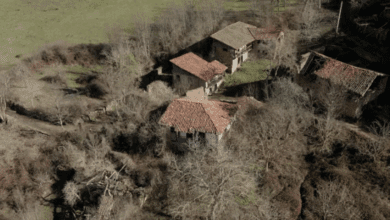
When you enter this enclave of Aunamendi, the first thing you notice is the silence, filled with echoes of the past. The damp air, the fine drizzle locals call ‘chirimiri,’ and the dense surrounding forests create the impression that time has stopped here. This is not just a picturesque mountain spot, but a starting point where history becomes tangible: medieval art, veneration of the Virgin Mary, and memories of the Camino de Santiago blend together, inviting visitors to immerse themselves at a leisurely pace in its story.
At the heart of the entire complex stands the Collegiate Church of Santa María, built in the 13th century. This structure became one of the first examples of Gothic architecture in Spain, erected by order of King Sancho VII the Strong. Its soaring vaulted naves and vibrant stained glass windows draw the eye to the main relic – a Gothic sculpture of the Virgin Mary, skillfully covered in silver by Toulouse craftsmen. Locals reverently call her “Queen of the Pyrenees.” Directly beneath the altar lies a crypt connected to the monarch, where you can still see geometric Gothic-style paintings and windows made from translucent alabaster.
The cloister adjoining the church houses the Chapel of Saint Augustine, which became the final resting place of Sancho VII himself. His tomb is an impressive work of art. Directly opposite stands perhaps the most famous exhibit of the complex—the celebrated chains captured at the Battle of Las Navas de Tolosa. This trophy became more than just a relic; it is a central element of the coat of arms of Navarre, symbolizing a turning point in the history of the Reconquista and the valor of the Navarrese army.
The museum-library attached to the church preserves true rarities within its walls. Of particular interest is the so-called “Charlemagne Chess Set.” For centuries, it was revered as the game board of the legendary emperor, but in reality it is a refined Gothic 14th-century altar-reliquary, adorned with Limoges enamels. The collection also features other artifacts: an emerald, believed to have belonged to the Almohad caliph Miramamolin, and a Romanesque gospel in a precious silver casing. Each item here is not just an exhibit, but a witness to great events.
Nearby stands the oldest building in the entire ensemble—the Chapel of the Holy Spirit, also known as the “Silo of Charlemagne.” Tradition associates this funerary structure with those who fell in battle alongside Roland and his companions. The austere room with pointed vaults, stone steles, and a lamp in the shape of a Visigothic crown makes a strong impression, transporting one back to an even more distant past—to the era of epic legends and great heroes.
Visiting the monumental complex is designed for everyone. A full ticket costs 6 euros, with discounts available for various visitor categories. There is also a shorter route that allows you to see the monarch’s tomb and the cloister. The Santa María church itself is open for free admission throughout the day, and daily masses are held. Families with children can enjoy the exciting “Reto de Roncesvalles” quest, while nature lovers will find marked trails starting just outside the complex. These trails pass through beech and oak groves, which blaze with every shade of ochre and burgundy as the cooler season arrives.