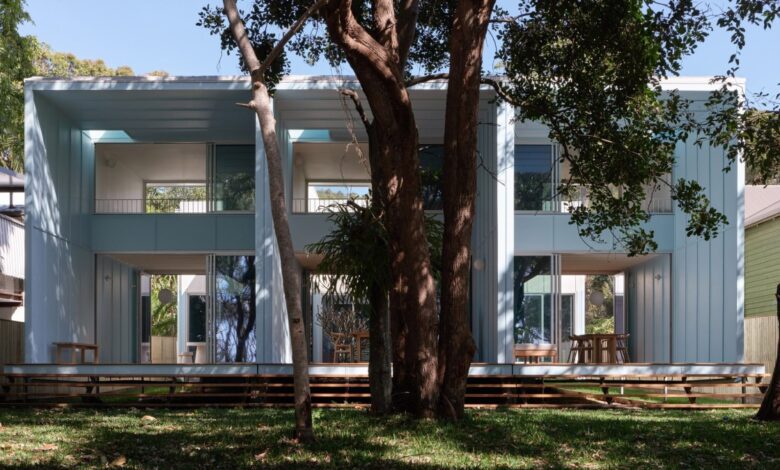
On the coast of Queensland, where the ocean meets dense eucalyptus groves, an unusual architectural ensemble has emerged. Three identical houses, as if cut from the same mold, have appeared on North Stradbroke Island. The clients were three sisters who decided not just to build homes, but to create a space for living together without sacrificing personal freedom. Their childhood memories of summer vacations on this island became the starting point for a new family experiment.
The project, named Blok Three Sisters, was carried out by the Australian company Blok Modular and the architecture studio Vokes and Peters. All elements of the houses were manufactured at a plant in Brisbane, then delivered to the island and assembled on site. This approach minimized environmental impact and sped up the construction process—crucial factors for remote locations.
Each building is not just a copy of its neighbor, but a thoughtfully designed unit able to adapt to changes in its residents’ lives. The architects prioritized flexibility: the ground floor can function as a separate apartment, which is convenient for elderly family members or guests with special needs. Internal courtyards and terraces separate private and communal areas, creating a sense of seclusion even in close proximity.
An Architectural Formula
The houses present a minimalist exterior: white facades, tall windows, and wooden panels. Yet this simplicity conceals a sophisticated spatial layout. The second floor features extra bedrooms and a bathroom filled with natural light, with one room facing the inner courtyard and another looking out onto the street. To ensure residents’ privacy, the facades are equipped with tall windows and wooden screens that serve both as design elements and barriers from prying eyes.
Much attention was paid to the details: sliding doors that open onto spacious verandas connect the interior with the surrounding nature. Each house offers dedicated areas for relaxation, work, and socializing, making them versatile for different stages of family life. Architects emphasize that the project was conceived with future changes in mind: the houses can be easily adapted to new needs without losing their unique character.
The placement of the buildings in relation to each other is also crucial. Together, they form a semi-enclosed ensemble, with each house facing a shared garden. This design creates a distinctive atmosphere—residents can easily gather over a cup of tea, but also enjoy privacy without leaving the comfort of their own space.
Shared garden
At the heart of the complex lies a large garden surrounded by mature trees. It’s here that all residents’ paths cross and life takes on a special rhythm. This spacious green area is not just a place for relaxation but also a unique symbol of unity. The kitchens and dining rooms of all three houses open directly into the garden through glass doors, blurring the line between home and nature.
Family meals, children’s games, and evening conversations all take place in the shade of the trees. The garden becomes a stage for spontaneous meetings and shared rituals that create new traditions. At the same time, everyone can find their own secluded corner—the architects have provided numerous hidden zones where you can be alone with your thoughts or a book.
From the second-floor living rooms, you can gaze out over the Pacific Ocean, giving the space a special sense of depth. In the evening, salty breezes drift in and moonlight reflects off the white facade panels. The atmosphere evokes childhood, when anything seemed possible and a house was not just a place, but a world of its own.
Life without compromise
Blok Three Sisters is more than an architectural experiment—it’s an attempt to rethink the very idea of communal living. Here, there are no rigid boundaries between private and shared, past and future. Each house preserves memories but remains open to change. In this project, repetition becomes an advantage rather than a drawback: identical houses allow you to focus on what truly matters—the substance of life, not external differences.
The creators of the project emphasize that the garden is more than just a physical space—it’s an emotional center where the scents of jasmine, the sound of the surf, and the moonlight come together. Time flows differently here, and familiar rituals take on new meaning. In a rapidly changing world, such projects become islands of stability and comfort, offering a place to be oneself and, at the same time, feel part of something greater.
The balance between autonomy and community is approached in an unusual way: each house is completely independent, but not isolated. This allows residents to choose how involved they want to be in the community without feeling pressured or uncomfortable. This approach can serve as a model for other families seeking a balance between personal freedom and closeness.
Trends of the Future
The emergence of such complexes on the Australian coast is no coincidence. In recent years, architects have increasingly turned to modular construction, which allows for the rapid building of quality homes with minimal impact on the environment. The repetition of forms is combined with opportunities for individual customization, while communal spaces have become the heart of resident life.
Blok Three Sisters demonstrates that even in a limited space it’s possible to create a harmonious environment for multiple generations. The project shows that architecture can not only reflect but also shape new models of family life. There is no place for random decisions here—every detail is considered, every area has its purpose.
Perhaps it is projects like these that will address the challenges of our time, as traditional forms of housing no longer meet society’s needs. Modern families are looking for new ways to organize their lives, and architecture is ready to offer them innovative solutions.
If you weren’t aware, Blok Modular is one of Australia’s leading companies in the field of modular construction. The firm specializes in creating modern residential and commercial spaces, with a strong focus on sustainability and innovative technologies. The architectural studio Vokes and Peters is renowned for projects that combine minimalist forms with a deep understanding of context. Their work has earned numerous professional awards and is recognized as a benchmark of contemporary Australian architecture.