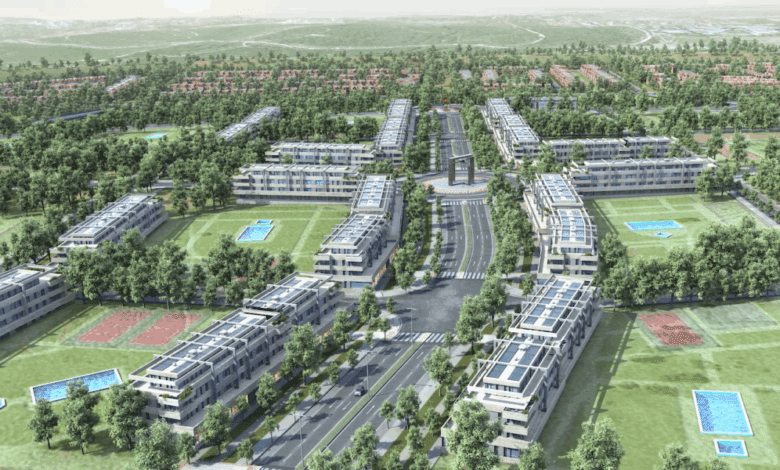
In 2025, Spain’s urban landscape underwent a dramatic transformation. Within just a few months, projects that had long seemed permanently stalled were either launched or unblocked. As a result, construction began on more than 100,000 new homes across the country, and the familiar skylines of cities are rapidly changing. This shift is especially evident in Madrid, Barcelona, Zaragoza, and in the south, where developers and authorities are pouring all resources into boosting the housing stock. Amid this construction boom, experts are increasingly warning: unless the preparation of new plots speeds up, Spain will face a severe shortage of residential land in just a few years.
The year began with the long-awaited revival of major projects that had been on hold for years. In Zaragoza, for example, the Arcosur district finally got moving—work began on 17,000 apartments that had stood idle for more than a decade. In Andalusia, large-scale construction kicked off in Retamar de la Huerta, where another 3,500 new homes will be built. These developments have become symbols of a new stage of regional growth, where housing demand has long outpaced supply.
Madrid emerges as the new urban hotspot
The undisputed leader in pace and scale has been the metropolitan area of Madrid. In the capital and its surroundings, dozens of new neighborhoods were launched in 2025, while older projects found new momentum. In the western part of the region, in the municipality of Brunete, plans for the SR-1 site were approved—nearly 3,000 new apartments will be built here. The southern and western suburbs are also keeping up: in Alcorcón, Pozuelo, and La Solana, more than 22,000 new homes are planned in total.
Particular attention was drawn to a megaproject in Paracuellos de Jarama, where developers announced the construction of 7,200 apartments—one of the largest residential complexes launched this year. Eastern areas of Madrid have not lagged behind either: in Valdecarros, the start date for the first phase has already been set—13,000 apartments, and the area could eventually see up to 20,000 new homes. In San Sebastián de los Reyes, preparations are underway for 3,600 apartments in the Cerro del Baile district. In the Campamento neighborhood, authorities have removed the last bureaucratic barriers, paving the way for the phased development of a new residential area.
Legal Battles and Innovations
There was no shortage of high-profile legal disputes. One of the most discussed events of the year was the case of the Valgrande district. After months of uncertainty and court proceedings, the project finally received approval to build 8,600 apartments. Until recently, the Supreme Court was delaying the timeline for the project, but now developers can move forward. This story clearly demonstrates how legal nuances can stall the development of entire neighborhoods.
Completely new types of housing are also emerging in central Madrid. In the Ermita del Santo district, construction has begun on a high-rise tower that will offer not only rental apartments, but also modern co-living spaces. This approach targets young professionals and those who value mobility and flexibility. It’s an example of how perceptions of urban living and housing in large cities are evolving.
Частные инвестиции и инфраструктура
2025 will also be remembered for major land deals. Azora acquired a plot of half a million square meters in Valdecarros, with plans to build more than 3,500 apartments. Another noteworthy deal is a strategic alliance between Culmia and Patron Capital, who are jointly developing a project with 168 apartments in one of the most sought-after areas of the capital region.
The rapid growth of residential construction has raised doubts about the capacity of existing infrastructure. Representatives of energy companies AELEC and the developers’ association Asprima have called on authorities to urgently upgrade power grids to ensure stable electricity supply for new neighborhoods. The long-awaited Madrid Nuevo Norte project is also on the horizon: developers have confirmed that the first apartments will be delivered as early as 2027. This will mark one of the largest urban transformations in the country’s history.
Barcelona and Other Regions
The trend is not limited to the capital. In Barcelona and its suburbs, especially in the Vallès Occidental area, developers are actively expanding into new territories. Demand for housing here remains consistently high, and prices continue to rise. Major land deals were closed over the year: Atalaya invested 8.2 million euros in plots in Los Berrocales and Arpo, strengthening its position in Madrid’s new residential development market.
Andalusia and other regions have also seen a surge in construction activity. New projects are emerging in cities where large-scale development seemed unlikely until recently. This signals that Spain’s housing market is undergoing rapid changes, and the reach of new construction is becoming increasingly diverse.
In case you didn’t know, Azora is one of the largest real estate players in Spain, specializing in investments in residential and commercial properties. The company is actively involved in developing new districts, acquiring large plots of land and carrying out large-scale projects. In recent years, Azora has established itself as a reliable partner for municipalities and private investors, with its projects often driving growth across entire urban areas.