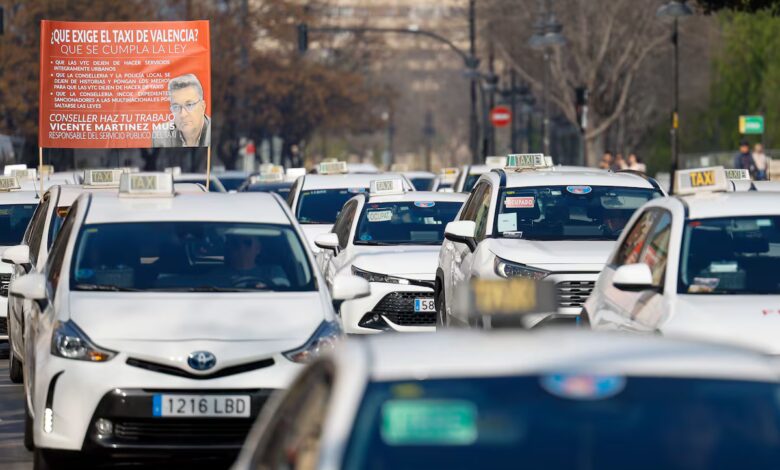
On Wednesday, thousands of taxis in Valencia and other cities across the region went on a 24-hour strike. The decision was a response to growing discontent among drivers over competition from VTC services. For residents and visitors, this meant the usual transport was unavailable at train stations, the airport, and on city streets. The debate over the balance between traditional taxis and new transportation services has become one of the most pressing issues throughout the region.
From early morning, drivers gathered in various areas of Valencia to march towards the historic Torres de Serranos gates. According to industry associations, about 3,000 vehicles from Valencia, Alicante, and Castellón took part in the protest. After the march, the convoy headed to the regional government headquarters—Palau de la Generalitat—where the protest continued on foot. That day, taxis were absent from Joaquín Sorolla station, Estació del Nord, the bus terminal, and the airport. Exceptions were made only for emergencies and hospital trips.
Causes of the conflict
The main complaint of drivers is the lack of clear regulations for VTC, which, in their view, threatens the existence of traditional taxis. According to the head of the regional taxi drivers’ confederation, more than 8,000 families depend on this profession. Drivers fear that if the situation does not change, the industry could disappear. They demand a halt to the issuance of new city licenses for VTC and insist on discussing fares, the number of vehicles, and other conditions, but are strongly opposed to handing the market over to large companies and non-professional drivers.
Regional authorities, according to El Pais, have stated that the interests of residents remain their top priority. Negotiations are currently underway with representatives from both sides—taxis and VTC. A new regulatory act is expected in the near future, which aims to implement stable rules for all carriers and ensure their coexistence. However, taxi representatives believe that the joint operation of both systems is virtually impossible.
VTC response and authorities’ reaction
While taxi drivers are protesting, VTC representatives are preparing their own demonstration. Already the day after the strike, they plan to organize a ‘slow’ car procession through the streets of Valencia. Their unions are concerned that the new regional decree could cut the number of VTCs in cities by nearly 40% and threaten around 5,000 jobs. The conflict between the two transport sectors is becoming increasingly apparent, and resolving the issue affects thousands of families and influences transportation accessibility for all residents of the region.
In recent years, Spain has already faced large-scale transportation protests. For example, a recent railway strike led to the cancellation of hundreds of trains and major scheduling disruptions nationwide, as detailed in the article on how train drivers’ demands impact the transportation system. Incidents like these demonstrate how sensitive the sector is to any changes and how quickly they can affect the daily lives of millions.
Context and consequences
The issue of regulating taxis and VTCs is being discussed not only in Valencia, but also in other regions across Spain. In recent years, Madrid and Barcelona have likewise seen mass protests by drivers demanding restrictions on the operation of new ride-hailing services. Authorities in various autonomous regions are tackling the issue differently: some impose quotas, while others tighten licensing requirements. However, none of these options have yet resulted in full consensus among market participants.
Experts note that such conflicts reflect broader changes in the economy and employment patterns. The growth of platform-based services and digital solutions is transforming established rules, forcing traditional sectors to adapt to new realities. In the coming months, the situation in Valencia may become a reference point for other regions, where similar disputes are only gaining momentum.
Overall, the taxi drivers’ protests and the VTC response are part of a broader transformation of Spain’s transport system. How quickly a compromise can be reached depends on all parties’ willingness to engage in dialogue and on the authorities’ ability to propose solutions that address the interests of both drivers and passengers.