The scandal surrounding the piñata resembling Pedro Sánchez has once again drawn the attention of Spanish society. The issue of where to draw the line between political protest and threat has become the subject of a court case that could influence future decisions in similar situations. For many in Spain, this trial matters not only because of the president himself, but also due to possible implications for freedom of expression and street protests.
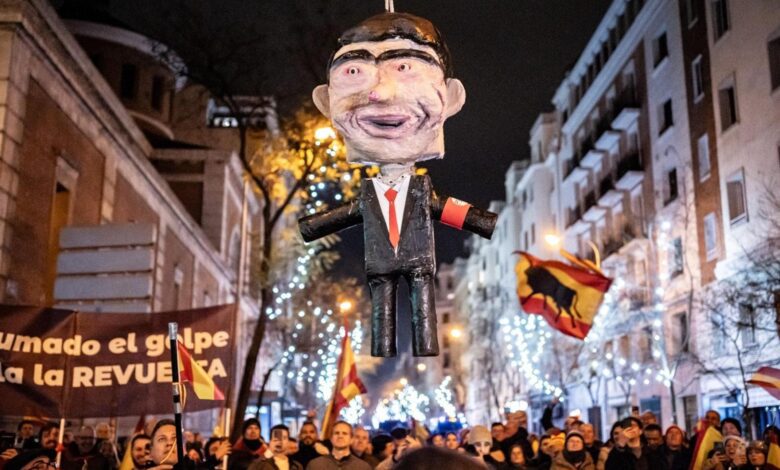
At the beginning of 2024, a piñata with Pedro Sánchez’s face appeared on Ferraz Street in Madrid. It was hung from a rope and struck by demonstrators. The president of Spain told the court that he interpreted this act as a direct call for his removal and said he felt anxiety and concerns for his safety and the safety of his family. According to Sánchez, the actions of the protesters could serve as a signal for actual attacks.
Defense arguments
However, the defense for one of the accused insists that Sánchez only learned about the incident the next day, and only through a press review prepared by his staff. The lawyer argues that there was neither a direct nor an immediate threat, and that the perception of a threat only arose after the information spread in the media and on social networks. The defense maintains that in order for a threat to be recognized, there must be specific signs of intimidation, which are absent in this case.
The lawyer emphasizes that the case files contain no evidence of actual harm or threat that goes beyond political criticism. He notes that the emotional distress described by the president is not supported by objective facts. As a result, the defense demands that the investigation be closed, arguing that the defendants’ actions do not fall under the statute on criminal threats.
Court rulings and new developments
Judge Concepción Jerez had previously closed the case, ruling that the piñata did not constitute an act of hate but was instead a form of political satire. However, in July 2025, the Madrid provincial court ordered the investigation to be reopened, considering the earlier decision premature and pointing to possible signs of threats in the actions of the event’s participants. As a result, six individuals linked to organizing the event are again under investigation.
In his latest statement, the defendant’s lawyer draws attention to the fact that Sánchez’s written testimony contains no specific evidence of harm or threats beyond the boundaries of symbolic protest. He also points out that sharing information about the piñata online cannot, by itself, turn the event into a criminal act.
Context and consequences
The case involving the piñata on Ferraz has become one of the most talked about in Spanish society, as it concerns the balance between freedom of expression and the protection of public officials. According to RUSSPAIN, such proceedings often spark debates about the acceptable limits of political criticism and the responsibilities of street protest participants. Attention to this case is heightened by the fact that similar situations have previously led Spanish courts to reconsider decisions related to public protests and symbolic acts.
In the context of court rulings, it is worth noting that recently the Spanish Prosecutor’s Office also submitted an appeal to the Constitutional Court in another high-profile case involving actions by state bodies. More on the reaction of authorities and legal experts to such proceedings can be found in the article about the prosecutors’ complaint in the García Ortiz case.
In recent years, there have been repeated debates in Spain over events that some see as forms of protest and others view as threats or insults. For example, in 2023, an installation in one of Barcelona’s main squares provoked a heated public reaction and subsequent court proceedings. Similar cases have occurred in other regions, where courts interpreted the boundaries of permissible public expression differently. These events show that the issue of freedom of expression and responsibility for symbolic acts remains relevant for Spanish society and its judicial system.