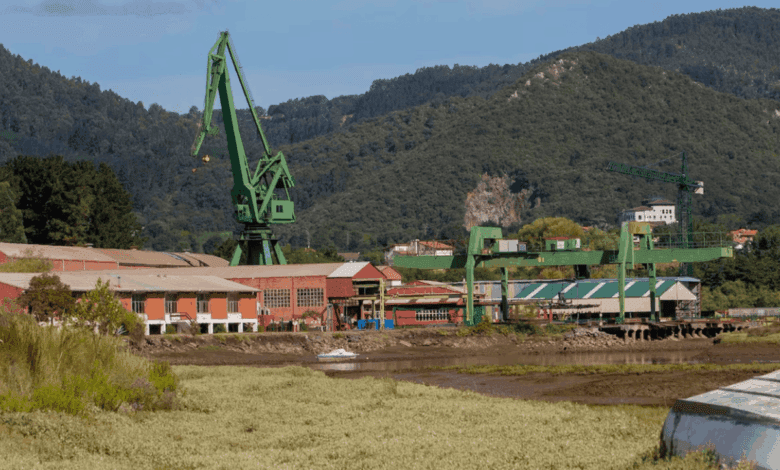
One of the most high-profile environmental battles in recent years has ended in the Basque Country. The authorities’ decision to abandon plans for a Guggenheim museum branch in Urdaibai marks a real victory for environmentalists. This area is the region’s only biosphere reserve, and the attempt to place a major cultural facility here sparked outrage among local residents and ecological organizations. Now that the project has been officially shelved, public attention has shifted to another pressing issue—the restoration of the marshland, which for decades housed the Astilleros Murueta shipyard.
The Guggenheim Urdaibai Stop platform—which brought together activists and residents from Busturialdea, Gernika, Mundaka, Forua, Bermeo and other municipalities—is openly celebrating. According to them, the ‘main threat’ to this unique natural complex has disappeared. But their fight isn’t over. Now they demand not only recognition that the shipyard’s expansion was illegal, but also that authorities require the company to completely vacate and restore the marshlands.
A shift in priorities
The question of building the Guggenheim in Urdaibai had been debated for years. Supporters of the project saw it as an opportunity for the region’s economic and cultural development, while opponents insisted that no benefits could justify the destruction of its fragile ecosystem. In December 2025, the authorities officially announced the termination of all work and dropped the idea of locating the museum in the nature reserve. The decision was the result not only of public pressure, but also of legal complexities related to the protection of natural areas.
The provincial deputy of Bizkaia, Elixabete Elantxobe, admitted that the regulatory framework does not allow such a large-scale project to go forward under strict environmental restrictions. According to her, the uniqueness of the Guggenheim cannot be realized in a place where the law decisively protects nature.
New target: the marshes
After forcing the museum project to a halt, activists shifted their focus to fighting Astilleros Murueta. This shipyard has operated in the very heart of the marshes since 1943, gradually expanding beyond its originally allocated land. According to a technical report commissioned by the platform from an independent consulting company, more than half the area occupied by the company is used without any legal basis. Experts note that, if not for artificial embankments and dams, this entire zone would be regularly flooded by seawater, confirming its natural status.
Civil activists are demanding immediate government intervention. They are calling for a review of the land boundaries, official recognition as part of the national maritime fund, and complete restoration of the natural landscape. Petitions have been sent to the Ministry for the Ecological Transition and Demographic Challenge, as well as to the Coastal Directorate. Their goal is to secure official acknowledgment of the illegality of the current situation and force the shipyard to leave the marsh.
Celebration and Protest
While officials review documents and prepare responses, activists aren’t wasting any time. A large-scale event is set for February 7—a farewell party for the Guggenheim project. Organizers promise not only festivities but also bold statements: they aim to show that a united community can halt even the most ambitious government and business initiatives if they threaten the environment.
But beneath the festive surface lies a tense battle. Representatives of the platform openly state: “This is just the beginning.” Their goal is not only to return the marsh, but to set a precedent for all of Spain. If the eviction of Astilleros Murueta succeeds, it will send a message to other regions: illegal use of natural territories will not go unpunished.
Legal Battles
At the heart of the conflict are complex legal issues. The shipyard refers to old permits issued as far back as the mid-20th century. Activists, however, claim that most expansions and constructions were carried out without any documentation. A technical report commissioned by them provides a detailed analysis of the areas occupied by the enterprise and shows that more than 56% of the territory is used outside the law.
Authorities are not rushing to take tough measures for now. Officials emphasize the need for a thorough review of all facts and for proper procedures to be followed. But public pressure is mounting, and it is becoming harder to ignore. The future of the Urdaibai marshes has moved beyond a local dispute—it has become a symbol of the struggle to protect nature in modern Spain.
A test for the region
The situation in Urdaibai is more than just a land dispute. It is a clash of two worldviews: some see nature as a resource for development, while others value it as something that can’t be measured in money. The activists’ victory over the Guggenheim project showed that public opinion can change the course of history. But ahead lies an even tougher battle for the restoration of the marshes and justice.
Who will prevail in this standoff remains an open question. But one thing is clear: no one is indifferent anymore. Urdaibai has become the stage where the fate of not just a single region, but the entire country, is being decided.