Many travelers dream of seeing the world’s greatest cities—Paris, Rome, or faraway New York—with their own eyes. People save for years to buy tickets and plan out their routes in detail, eager to touch history and witness monuments that define entire eras. Yet few realize that to feel the spirit of American freedom, you don’t have to cross the ocean. Hidden from the public eye, a true treasure waits inside one of Barcelona’s historic buildings—ready to transport you straight to Liberty Island.
This remarkable journey into miniature America begins not on a busy square or in a shady park, but within the quiet grandeur of the Biblioteca Pública Arús. More than just a book repository, the library made history as the first public institution of its kind, opening its doors to the people of Barcelona and becoming a true beacon of knowledge and culture. Located on the elegant Passeig de Sant Joan, the building itself is an architectural monument—but its most intriguing secret awaits inside.
Catalonia’s Lady Liberty
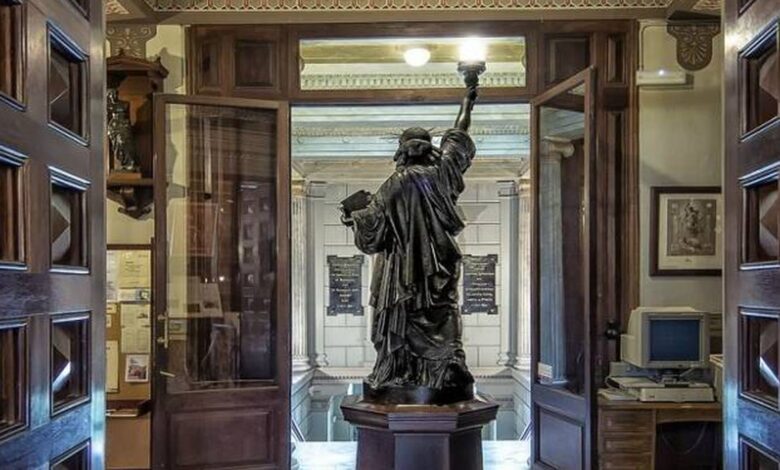
No sooner do guests cross the threshold than they stop in awe. They are greeted by a familiar silhouette—a bronze figure of a woman holding a torch, uncannily reminiscent of the famous New York statue. However, this version is far more intimate. It stands just about two meters tall, a striking contrast with its 46-meter American ‘sister’. Despite its modest size, the Catalan statue matches its counterpart in grace and symbolism.
This unique sculpture was created more than 120 years ago at the end of the 19th century. It was crafted by the talented Catalan artist Manuel Fuxà i Leal, with Italian bronze specialist Odoardo Luis Razzauti assisting in the metalwork. Their collaboration produced not just a replica but an independent work of art with its own distinct character.
Freedom of the soul, not the state
The main differences are in the details. Take a closer look at the book Lady Liberty holds in her left hand and you’ll notice a key distinction. The plaque on the New York monument is engraved with the date of the signing of the US Declaration of Independence. The Barcelona statue, however, carries a different message. Inscribed in Latin on her book is the phrase: “Anima Libertas”.
This phrase translates as “Freedom of the Soul.” The choice is far from random and carries deep symbolism, as the sculpture is located in a library—a place where the mind is liberated through knowledge, reading, and exploration of the world. It is a tribute not to political, but to intellectual and spiritual freedom. This is the detail that turns the statue from a simple copy into a unique artifact with profound philosophical meaning.
How to See the Treasure
Anyone wishing to see this marvel in person can visit the Arús Public Library. Doors are open to visitors on Mondays, Wednesdays, and Fridays from 10:00 to 15:00, and on Tuesdays and Thursdays from 15:30 to 20:30. To fully experience the atmosphere of the place, joining a guided tour is highly recommended. Guides will share not only the secrets of the statue, but also the library’s rich history, its unique collections, and its role in Catalonia’s cultural life.
By the way, the Arús Library was founded in 1895 according to the will of philanthropist and playwright Rossend Arús. He was a well-known Mason, and the library was originally created to educate the working class—to provide ordinary people with access to knowledge. Today it houses one of the most important collections in Spain dedicated to Masonry, anarchism, and the labor movement. This historical context gives the statue with the motto “Freedom of the Soul” an even deeper and more multifaceted symbolic significance.