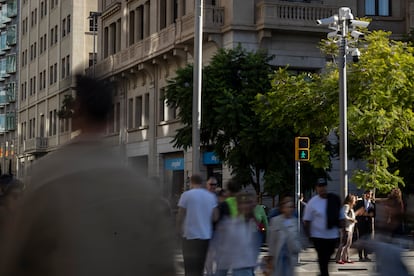
The Barcelona municipality has announced a large-scale expansion of its video surveillance system. Over the next two years, 500 more cameras will be installed on city streets, tripling the current number. By 2027, the Catalan capital will have 660 devices monitoring public spaces.
Barcelona’s video surveillance system began developing relatively recently. The first camera appeared in 2001 at George Orwell Square (George Orwell) in the Gothic Quarter. Until 2019, there were only 62 cameras, mainly in the historic center and the Eixample district (Eixample). The number then increased to 160, and the most recent one was installed in October 2024 on Sant Oleguer Street (Sant Oleguer) in the Raval neighborhood (Raval).
The planned expansion will take place in several stages. The first phase is set to begin in the coming weeks: 134 cameras will be installed on Plaça Catalunya and nearby streets, with some replacing outdated models. Special attention will be given to the Barceloneta promenade (Barceloneta), where additional devices will be added by 2026. The second and third waves of expansion will cover another 121 locations, and by the end of 2027, another 245 cameras will be added.
Placement criteria and legal considerations
The placement of new cameras is determined by several factors. Priority is given to areas where crime is on the rise, spots with ongoing disputes among residents, and zones frequently crowded with people. Recommendations from European security projects for public events and anti-terrorism measures are also taken into account.
Before installation, each camera is approved by the Catalonia Video Surveillance Oversight Commission and receives authorization from the regional authorities. Not a single application from the city has ever been rejected. All devices are connected to a central control center on Lleida street, where only the city police have access to the footage.
Technology and limitations
The new cameras will not be equipped with facial recognition or artificial intelligence systems for identifying citizens. Their purpose is to record violations and assist in investigating incidents without infringing on privacy rights. All areas where cameras are installed will feature special informational signs.
The average cost of each device is about 28–30 thousand euros. After the project is completed, more than 5% of the city’s territory will be under video surveillance. Authorities believe this will not only help solve crimes, but also reduce anxiety among residents, for whom security remains a top concern.