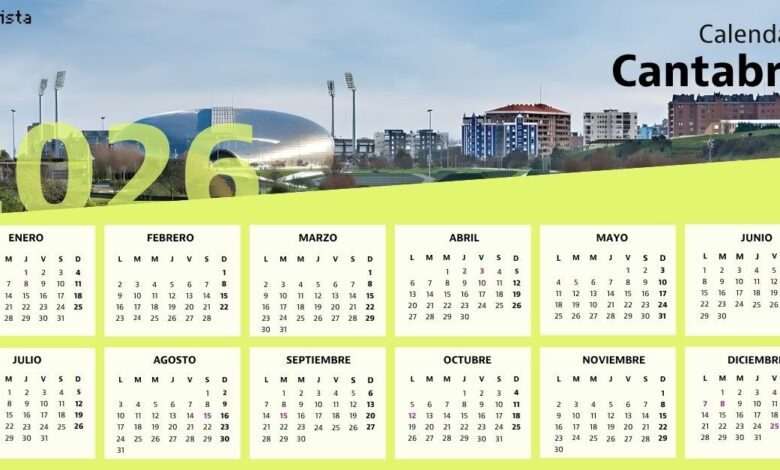
The authorities of the autonomous community of Cantabria have officially unveiled the 2026 work calendar, which will serve as a guide for planning work hours and time off for all residents of the region. This eagerly awaited document, both by employees and employers, sets out all the public holidays across the autonomous community. In total, Cantabrians will have twelve paid days off with no make-up required, plus an additional two holidays established by each municipality.
National Holidays in 2026
As throughout Spain, Cantabria will observe national holidays that are an integral part of the country’s cultural and social life. These days bring all Spaniards together through shared traditions and opportunities for family gatherings and travel. In 2026, the national holiday calendar is as follows.
January 1 (Thursday), New Year (Año Nuevo): The start of the year is traditionally a day off. It’s a time to rest after lively celebrations, enjoy family meals, and make plans for the next twelve months.
January 6 (Tuesday), Three Kings’ Day or Epiphany (Epifanía del Señor): One of Spain’s most beloved children’s holidays, marking the end of the Christmas season. Colorful ‘Cabalgata’ parades take place in cities the night before, and in the morning, children find gifts brought by the magical kings.
April 3 (Friday), Good Friday (Viernes Santo): The most important day of Holy Week (Semana Santa). In Cantabria, as throughout the country, solemn religious processions take place. Especially famous is the Passion Play in Castro-Urdiales, which attracts thousands of spectators.
May 1 (Friday), Labor Day (Fiesta del Trabajo): The International Workers’ Solidarity Day, which in Spain is marked by demonstrations and rallies organized by trade unions, but for most people is simply an extra spring holiday.
August 15 (Saturday), Assumption of the Virgin Mary (Asunción de la Virgen): This religious holiday falls at the peak of summer and vacation season. In many towns and villages of Cantabria, it coincides with local patron saint fiestas filled with music, dancing, and fairs.
October 12 (Monday), National Day of Spain (Fiesta Nacional de España): The country’s main national holiday, also known as Día de la Hispanidad. A military parade is held in Madrid, and across the country official events highlight national unity.
December 8 (Tuesday), Immaculate Conception of the Virgin Mary (La Inmaculada Concepción): A major religious holiday which, together with Constitution Day (December 6), often creates a long weekend known as the “puente de la Constitución,” giving Spaniards a chance for a getaway before Christmas.
December 25 (Friday), Christmas (Natividad del Señor): The main family holiday of the year, which Spaniards celebrate with loved ones over a lavish dinner. It is a day of warmth, comfort, and traditional Christmas dishes.
Regional Holidays: What’s in Store in Cantabria
In addition to nationwide Spanish holidays, Cantabria’s calendar features its own unique celebrations that reflect the region’s history and cultural identity. These days are considered public holidays only within this autonomous community, making them especially meaningful for local residents.
April 2 (Thursday), Maundy Thursday (Jueves Santo): Unlike some other regions of Spain, Cantabria recognizes Maundy Thursday as an official holiday as well, giving people an extended Easter break. On this day, religious services and theatrical performances based on biblical events are held in the historic quarters of cities.
July 28 (Tuesday), Day of Cantabria’s Institutions (Día de las Instituciones de Cantabria): An important historical date dedicated to the formation of the region’s autonomy. The day is marked by official ceremonies, cultural events, and folk performances celebrating Cantabria’s history and traditions.
September 15 (Tuesday), Feast of the Apparition of the Virgin (Festividad de la Bien Aparecida): The day of Cantabria’s patroness. Thousands of pilgrims gather at the sanctuary to attend a solemn mass and honor their protector. It is a day of deep religious and cultural significance for all Cantabrians.
December 7 (Monday), Constitution Day transferred: Since Constitution Day (December 6) falls on a Sunday in 2026, the regional government has decided to move the public holiday to Monday, December 7, allowing residents to enjoy a long weekend at the start of winter.
Local fiestas: Santander celebrations
Every municipality in Spain is entitled to establish two additional public holidays tied to local festivities. The city council of Santander, the capital of Cantabria, has already set its dates for 2026. These will honor the city’s patron saints.
May 25 (Monday), Virgen del Mar (Virgin of the Sea): A festival in honor of Santander’s patroness. The day features a mass and a solemn procession, as well as public celebrations and a romería, drawing crowds of locals and visitors to the capital.
July 25 (Saturday), Santiago Apóstol (Saint James): The Feast of the Apostle Santiago, patron saint of all Spain, is also a major holiday in Santander. The day is marked by religious services and various popular festivities, celebrating the height of the summer season.
RUSSPAIN Fact Sheet. Cantabria is an autonomous community and historic region in northern Spain, bordered by the waters of the Bay of Biscay. Its capital is Santander. The region is famous for its lush landscapes, earning it the nickname “Green Spain.” Cantabria uniquely combines stunning beaches with the high peaks of the Picos de Europa mountain range. The area is also world-renowned for the prehistoric Altamira Cave and its cave paintings, often called the “Sistine Chapel of prehistoric art.”
Earlier, we reported that other regions of Spain are also actively releasing their calendars for 2026. For example, the authorities of Andalucía have already approved their schedule, which provides fourteen official holidays for residents of the southern region. You can find more details in our previous article on the topic Andalucía’s 2026 work calendar.