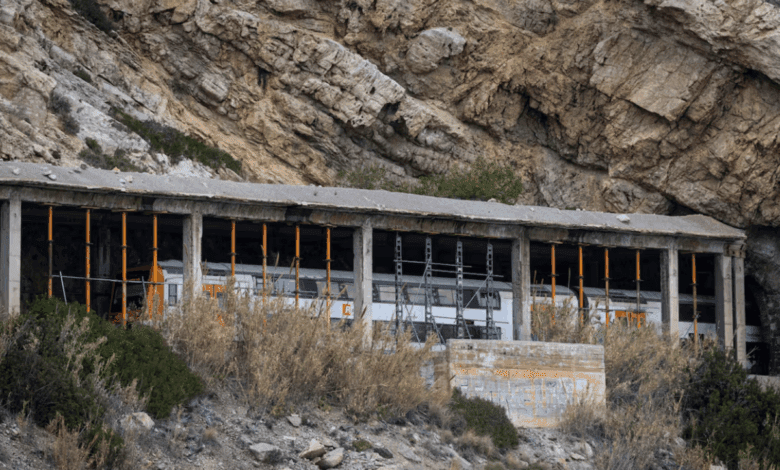
Residents of Catalonia are once again facing major disruptions in suburban train service. Friday morning began with the sudden closure of the R4 line section between l’Hospitalet de Llobregat and Martorell. The cause was a recent landslide in the Sant Feliu area, where large-scale track-deepening works are underway. The incident immediately affected thousands of passengers, forcing them to look for alternative routes and deal with delays.
Authorities acknowledged that it will take more than a day to restore normal operations. Railway company representatives advise using urban transport—trams, buses, and the metro. As a full replacement bus service has yet to be arranged, passengers have to transfer between different types of transport on their own. According to preliminary estimates, recovery efforts will last all day, and train speed restrictions will remain in place until April.
Consequences of the landslide
The landslide occurred in an area where track-deepening works are in progress, and although the railway itself was not directly damaged, train traffic became impossible. Railway officials note that full service can only be restored once all repairs are complete. In the coming weeks, passengers will have to cope with transfers and restrictions.
The Transport Secretary announced that a return to the usual timetable should not be expected before April. Until then, many sections will continue to have temporary speed limits, and some lines will operate with disruptions. In particular, the R3 line will remain partially closed until 2027 due to ongoing expansion works.
Alternative routes
On Friday morning, the situation on Catalonia’s railways became even more complicated. Although traffic was restored on some sections the previous day, new landslides once again disrupted the schedule. On the R1 line, trains run only as far as Blanes, where passengers have to change trains to continue to Maçanet-Massanes. Another transfer is required there—to a train bound for Portbou. The situation is similar on the R4 line: trains run between Sant Vicenç de Calders and Sant Sadurní d’Anoia, but from there to Martorell Central, passengers are transported by bus. After Martorell Central, train service resumes, but on the stretch to Manresa, passengers need to take a shuttle train.
The tunnel in Rubí, restored the previous day, is already being used for freight traffic. Structural reinforcement work has been completed here: cracks in the vault have been secured with steel plates, allowing train movement to resume. However, passenger services remain limited as a precaution.
Restrictions and delays
On Friday, passengers faced numerous restrictions and delays. On the R1 line, five trains per hour run between Hospitalet and Mataró, while only two operate between Mataró and Blanes. Service has been restored on the R2 line, but trains are running less frequently on the southern segment. The R3 line remains closed, and passengers must use buses on certain sections.
Special attention is being paid to the R4 line, the site of the recent tragedy in Gelida. Here, buses continue to run between Sant Sadurní and Martorell Central, while trains operate on schedule as far as Terrassa Estació de Nord. Beyond that, passengers must once again change to a shuttle train or bus to reach Manresa. Regional routes between Manresa and Cervera, as well as between Reus and Vinaixa, Reus and Riba Roja d’Ebre, and Reus and Plana Picamoixons, have also been temporarily replaced by bus services. The R8 line, which typically handles freight trains, is still not in operation.
Infrastructure works
The railway company is continuing work on 91 critical stretches of infrastructure simultaneously. Another 648 locations are undergoing preventive and maintenance operations. These measures are essential to prevent new incidents and ensure passenger safety. Despite all efforts, restoring stable service on all routes remains uncertain for now.
Previous reports have already addressed the issue of unstable rail service in Catalonia. After the accident in Gelida, passengers have repeatedly faced train cancellations, delays, and forced transfers. Authorities promised to speed up restoration, but deadlines keep getting pushed back. A detailed analysis of the situation and the causes behind the disruptions can be found on the portal RUSSPAIN.COM, where the impact on local residents and prospects for improving the transport system are examined.
In recent years, Catalonia’s railway network has repeatedly faced serious challenges. Landslides, accidents, and technical failures have led to widespread delays and train cancellations. The problem became especially acute after the incident in Gelida, when thousands of passengers were left stranded. The surge in such incidents has forced authorities to reconsider their infrastructure maintenance approach and tighten control over track conditions. Despite the measures taken, restoring stable rail operations remains one of the region’s main challenges.