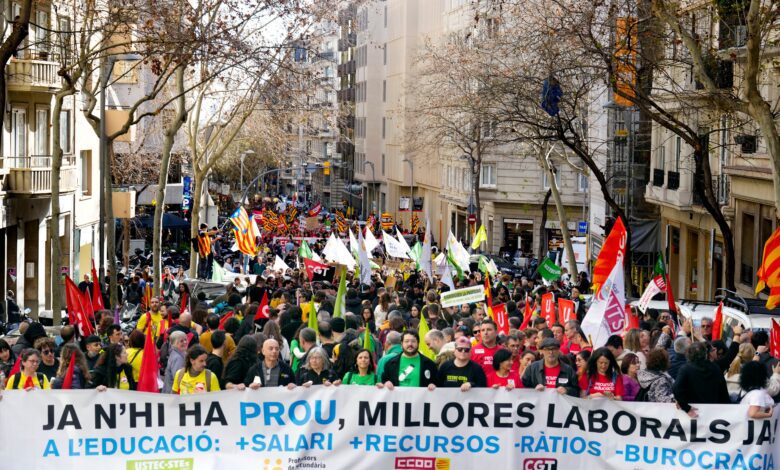
In Catalonia, the adoption of a new agreement to increase regional allowances for teachers has led to significant disagreements between unions and the authorities. This decision affects thousands of education workers and may shift the balance of power in negotiations over working conditions in the coming years. As El Pais reports, the consequences of this agreement are already being felt in the region’s educational institutions.
Agreement terms
The Catalonia Department of Education has signed an agreement with the CC OO and UGT unions, which are not among the largest in the sector. The document sets out a phased 30% increase in the regional salary supplement for teachers over four years. Currently, this allowance is about 700 euros per month. The agreement also mentions reducing the number of students per class in secondary schools, though exact figures have not yet been disclosed. Teachers who accompany students on trips will receive compensation of 50 euros for each night.
The compromise reached came as a surprise, as until recently the unions had acted as a united front. Now, some organizations have supported the authorities’ initiative, while others remain opposed. According to El Pais, this is the first agreement in recent weeks where the unions have failed to maintain a unified position.
Union reaction
The largest unions in the sector, such as Ustec and Profesores de Secundaria, have sharply criticized the agreements reached. They consider the proposed measures insufficient and point out that the agreement was signed only with representatives accounting for about 20% of all negotiation participants. In their view, this approach does not reflect the interests of the majority of education workers.
The dissenting unions have already announced their intention to continue with the strikes planned for next week. They emphasize that they will not drop their demands until more substantial improvements in working conditions and pay are achieved. As a result, the situation in Catalonia’s education sector remains tense, with the prospect of mass protests still looming.
Impact on the education system
The split among unions could lead to a prolonged conflict between education workers and authorities. For teachers who had hoped for a more significant pay increase and improved working conditions, the current agreement seems like a compromise and falls short of expectations. At the same time, regional authorities stress that the agreement represents progress in the negotiations and will allow for gradual improvements in teachers’ situation.
According to El Pais, disagreements between the unions could complicate further negotiations and delay the implementation of new initiatives in the education sector. In the coming weeks, attention will focus on how the parties seek a solution to the situation and whether they can reach a broader consensus.
In recent years, debates over teachers’ working conditions and salaries have repeatedly flared up in Spain. In 2024, similar protests took place in Madrid and Valencia, where educators also demanded higher pay and a reduction in workload. Negotiations at that time dragged on for several months, and some demands were met only after a series of mass demonstrations. These situations highlight that wage issues in education remain among the most sensitive for regional authorities and require an ongoing search for balance between budgetary constraints and workers’ expectations.