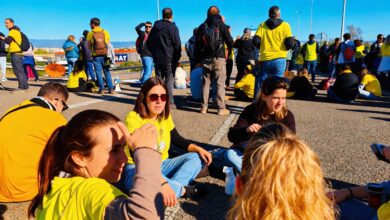
Large-scale teacher protests in Catalonia have gained new momentum, spreading across several regions. On Wednesday, the strike expanded to include the central areas of the autonomous community, Lleida, and the Pyrenees, resulting in major disruptions on key highways. For residents and businesses, this means not only difficulties in commuting but also possible changes in the operation of educational institutions.
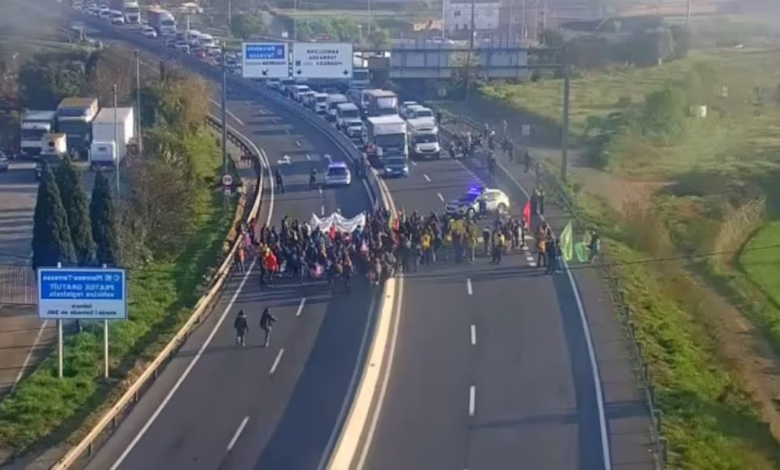
As reported by El Pais, activists blocked traffic on the A-2 highway in the Soses area from early morning, as well as the section between Lleida and Alpicat. At the same time, sections of the C-55 in Manresa, Solsona, and Clariana de Cardener, as well as the C-16c in Sant Fruitós de Bages, were also blocked. These actions caused significant traffic jams and delays, especially for those who rely on these routes for daily commutes to work or school.
Protests expand
At noon, at 12:30, mass demonstrations were held in Manresa, Lleida, and Seu d’Urgell, becoming the highlight of the third day of the strike. According to El Pais, the day before, protests had spread to Tarragona and Penedès, with around 4,000 educators taking part and school support rates reaching 39%—although official statistics included those on minimum duty shifts.
A week earlier, the strike began in Barcelonès and Baix Llobregat, where 8,000 teachers took to the streets, and absenteeism in educational institutions reached 32%. This trend reflects growing dissatisfaction among education workers and shows that the protests are gradually affecting more and more regions.
Impact on transport and schools
Road blockades have become one of the main tactics used by strike participants. This not only complicates travel throughout the region but also highlights the scale of discontent. Drivers stuck in traffic jams are forced to change their routes, and some schools have had to adjust their class schedules. According to russpain.com, such actions may lead to temporary disruptions in public transportation and additional costs for local municipalities.
Strike organizers have already announced that on Thursday, protests will move to Maresme and Vallès, and on Friday, a region-wide demonstration is expected, which could be the largest in recent months. So far, Catalonia’s authorities have not commented on possible measures to resolve the situation, but it is clear that tensions remain high in the education sector.
Consequences and expectations
According to El Pais, the current wave of protests covers a wider area and involves more active participation from teachers in various districts. This increases pressure on regional authorities and could accelerate the search for a compromise between teachers and administrators. Meanwhile, for parents and students, the ongoing instability means continued uncertainty in the learning process and possible changes to class schedules.
In the coming days, attention will be focused on how events unfold in new regions and how large Friday’s strike will be. If tensions escalate further, new road blockades and increased participation in protests cannot be ruled out.
In recent years, Catalonia has already faced large-scale protests in the education sector. For example, in 2022, teachers also took to the streets, demanding better working conditions and increased funding for schools. At that time, the protests were marked by mass demonstrations and temporary disruptions to the operation of educational institutions. Such events highlight that education issues remain among the most pressing in the region, with dialogue between educators and authorities often accompanied by public demonstrations and pressure on the government.