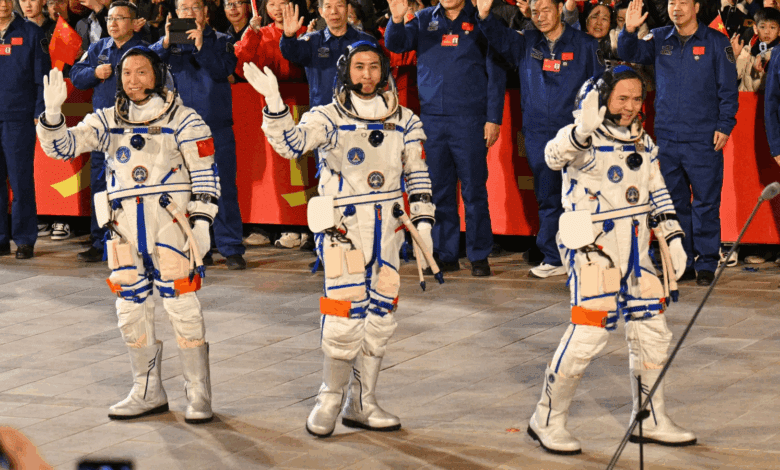
An unusual situation has arisen on the Tiangong orbital station: three Chinese astronauts, who arrived to relieve the previous crew, now have no way to return home on their own. Zhang Lu, Wu Fei, and Zhang Hongzhang arrived at the station on October 31 to replace the Shenzhou-20 team, whose mission was scheduled to end in early November.
However, shortly before returning to Earth, a crack was discovered in the Shenzhou-20 descent module after a collision with space debris. As a result, the crew had to use the capsule intended for the next shift in order to safely leave orbit. This forced measure allowed the astronauts to return home, but left their replacements without any means of descent.
The new Shenzhou-22 spacecraft was originally scheduled to launch to the station in spring 2026. However, given the circumstances, the Chinese space agency decided to fast-track the launch. The new launch date is now set for late November 2025 to ensure the Shenzhou-21 crew can return to Earth.
Despite the swift response, the situation remains tense. If another incident occurs on the station, such as another collision with debris, the astronauts will have no backup evacuation route. This increases the risk to their safety and requires constant monitoring of both the station and the surrounding space.
In recent years, China has been actively developing its space program, aiming for independence and technological leadership. The Tiangong station has become a symbol of these ambitions; however, the current incident highlights the vulnerability of even the most advanced projects in the face of unpredictable circumstances.
Currently, the Shenzhou-21 crew continues to carry out scientific and technical tasks on board while awaiting the arrival of a new spacecraft. In the coming weeks, experts will focus on ensuring their safety and preparing for an early return.