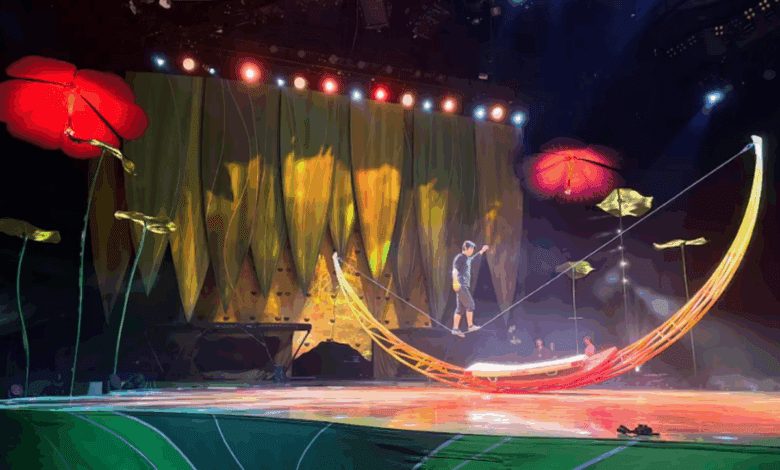
The arrival of Circo del Sol with the OVO show at the Movistar Arena has become a remarkable event for Madrid. For the first time, this large-scale performance is held not under the usual big top, but in a massive indoor arena, requiring a completely different approach to organization. For the Spanish audience, this is more than just another show — it is a new experience that sets new standards for cultural events in the capital.
As noted by El Pais, the dazzling production hides behind it a complex logistics operation. Circo del Sol must set up a full infrastructure at a new location each week. Instead of staying for extended periods at one venue as before, the team now moves from place to place, transforming each arena into a temporary city. This means that artists and technical staff live in a state of constant mobility, which affects how their daily routines and training are organized.
A backstage micro-city
OVO is not just a story about insects’ lives on stage, but also an example of how modern circus can adapt to different environments. For every new city, the team brings with them 21 trucks loaded with equipment, props, costumes, and even their own gym. At Movistar Arena, a mobile laundry arrives several days before the premiere, where more than 800 items of clothing and accessories are washed and dried. The entire process is set up so that performers can stay in top shape and prepare for shows in familiar conditions, despite the change in location.
Temporary workshops for sewing and repairing costumes operate nonstop. Every clothing item is custom-made, taking into account the performer and their role. For instance, the main character in OVO wears a prop egg on his back weighing 20 kilograms, while clown costumes are heavier and more complex. 3D scanning is used to create perfectly fitting outfits. The team includes specialists for specific elements: some focus solely on headwear, others on footwear.
Training and preparation
Circo del Sol performers do more than just rehearse on stage. Behind the scenes, there are dedicated areas for warming up, stretching, and individual training. A screen is also set up here to review recordings of previous performances for daily analysis and improvement. This approach helps maintain top performance levels and quickly adapt to new venues.
At Movistar Arena, a significant part of the backstage is dedicated to changing and preparation. Acrobats’ costumes are as light as possible so as not to restrict movement, with exposed wrists and ankles allowing freedom during stunts. The whole team works in harmony to have everything ready in a short time for each show. According to Circo del Sol representatives, by week’s end everyone knows where each item is, but it’s already time to pack up for the next city.
New standards for the show
Transitioning to performances in large venues not specifically designed for the circus requires Circo del Sol to constantly adapt. Unlike stationary shows in Las Vegas or extended tours under the big top, the OVO format involves a rapid change of cities and venues. This affects every aspect of organization — from logistics to cooperation with local services and the arena. Such experience may serve as an example for other cultural projects in Spain seeking new event formats.
As reported by El Pais, mobility and flexibility are becoming essential qualities for modern performers and organizers. Circo del Sol proves that even the most complex productions can be staged amidst constant relocations without sacrificing quality or spectacle. This creates new opportunities for hosting large-scale shows across different regions of the country.
Context and examples
In recent years, Spain has increasingly become a venue for major touring projects that require sophisticated logistics and quick adaptation. For instance, international music festivals and theater troupes use similar approaches, building temporary infrastructures in arenas and stadiums. This format helps attract new audiences and expand the reach of events. Circo del Sol’s experience with OVO in Madrid shows that modern technology and organization can shift established standards for cultural events, making them more accessible and varied for residents of different cities.