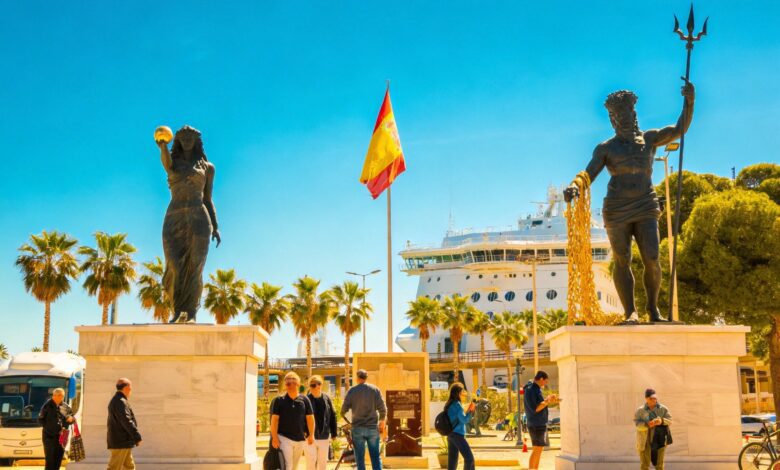
A new round of debate has erupted in Malaga after large-scale sculptures appeared at the entrance to the port, provoking mixed reactions from residents and cultural organizations. The authorities and the artist, Ginés Serrán Pagán, decided to forgo an official unveiling ceremony to avoid further controversy. This decision itself became a topic of discussion, as such measures are rare in the city’s cultural life.
The sculptural group, featuring a Venus with a golden sun, Neptune with a fishing net, and two lions, was installed on six-meter-high pedestals at the port entrance. According to El Pais, the works will remain in this location for six months despite protests from several public and cultural organizations. Many argue that the sculptures do not fit the city’s historic appearance and call for additional permits, which the project lacks.
Public reaction
The decision to cancel the official opening was explained as an effort to defuse public discontent. The sculptor noted he was tired of ongoing debates about his work and preferred to let the pieces speak for themselves. On the day the barriers around the sculptures were removed, passersby immediately appeared to take photos with the new installations, and some families even allowed their children to climb onto the lions for pictures.
Public opinion was divided: some expressed enthusiasm and shared positive impressions, while others criticized the choice of location and the appearance of the sculptures, comparing them to comic book characters. Representatives of cultural organizations, such as the Real Academia de Bellas Artes de San Telmo, described the composition as ‘pretentious’ and ‘kitsch’, and emphasized that installing works near the historic center requires approval from the regional authorities.
Agreement details
The initiative to install the sculptures came from Ginés Serrán Pagán himself, who offered to donate them to the city in memory of his father, a native of Villanueva del Rosario. According to the agreement, the artist covered production costs, while the port paid for installation, which was estimated at nearly 70,000 euros. Initially, the sculptures were planned to remain for 25 years, but following a wave of criticism, the period was reduced to six months.
At the beginning of the year, the port council approved the project by majority vote, despite protests from unions and government representatives. Later, to ease tensions, it was decided to limit the exhibition period and to forgo an official opening. According to russpain.com, similar situations involving the temporary installation of artworks in public spaces have become increasingly common in Spain.
Arguments of the parties
Critics of the project point out that the chosen site falls within the influence zone of the historic center, which is a cultural heritage site. In their view, installing the sculptures disrupts the city’s visual appearance and requires approval from the Junta de Andalucía. However, regional authorities do not consider this mandatory, which has only deepened the divisions between different groups.
The sculptor continues to emphasize the artistic value of his work, noting that such a large-scale bronze network is being seen in art history for the first time. He also expressed surprise at the negative reaction to the gift to the city, stressing that culture should remain above political games.
In recent years, Spain has seen repeated debates over the installation of new art objects in public spaces. For example, projects in Valencia and Barcelona have sparked protests among residents and experts due to perceived inconsistencies with the historic character or lack of proper approvals. In some cases, the works were dismantled ahead of schedule; in others, they remained following public discussions. Such situations highlight how acute the debate is in Spain over striking a balance between contemporary art and the preservation of cultural heritage.