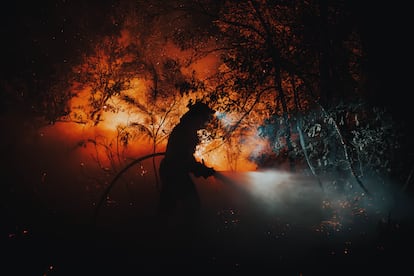
In the northwestern regions of Spain, the battle against large-scale wildfires continues, with villages and natural areas being destroyed for over a week. Lower temperatures have helped slow the spread of the fire and reduced the threat to populated areas, but the situation remains far from fully under control.
In Galicia, Extremadura, and Castilla y León, firefighters continue working under hazardous conditions. Despite a slight improvement in the weather, experts warn that due to dry soil and strong winds, the fires remain unpredictable. Many firefighters believe that only heavy rainfall can put an end to the disaster, but no rain is expected in the coming days.
Leaders of the affected autonomous regions express cautious optimism. In Extremadura, officials note that better weather conditions are helping stabilize the situation, and in Galicia, hopes are pinned on increased humidity. In Castilla y León, despite positive progress, a state of emergency remains in effect in the provinces of León, Zamora, and Salamanca at least until the end of the week.
In the province of Ourense, the number of active fire outbreaks has decreased from nine to seven in the past 24 hours, and five more have been stabilized thanks to cooler weather. Among them is the fire near Maceda, which had been raging for over a week and destroyed 3,500 hectares. However, the most critical situation remains in the municipality of Larouco, where, according to regional authorities, 20,000 hectares have burned in six days, and satellite estimates put the figure at up to 43,000 hectares. This is the largest wildfire in Galicia’s history, with 67,000 hectares already burned since the beginning of the year.
The difference in estimates is due to the fact that regional data only account for forest areas, whereas satellite monitoring also includes agricultural land. The Larouco fire threatens the O Courel mountain biosphere reserve and has already surpassed the recent Chandrexa de Queixa fire in scale, where around 18,000 hectares burned.
In Castilla y León, there are currently 29 active fire outbreaks; however, authorities affirm that no populated areas are under immediate threat. Residents of the Valdeón valley in León, who had previously been evacuated, have now returned home. Those who stayed behind to help firefighters are now headed to the municipality of Riaño to clear the area, as the danger persists on one flank of the fire.
Spanish Prime Minister Pedro Sánchez visited one of the hardest-hit areas — the municipality of Jarilla in the province of Cáceres, where the fire destroyed 15,500 hectares and spread into the territory of Salamanca. The situation here is now stabilizing, and all evacuated residents have been able to return to their homes. However, the fire remains active in the mountains, though there is no threat to populated areas. At present, firefighters are controlling two main hotspots: one descending the slopes of the Jerte valley, the other on the summit of Pinajarro mountain in Salamanca.
In the towns of Jerte and Tornavacas, where the fire is approaching, daily life is gradually returning to normal. Shops and workshops are open, construction continues, and people can be seen relaxing on outdoor terraces. The only reminder of the proximity of the fire is the thick white smoke trapped between the mountains. Some residents are still wearing masks, while others take advantage of the cooler weather to cycle along the mountain roads.
Smoldering embers pose a serious risk, as they can be carried by the wind and spark new fires. Despite improvements in the situation, air temperatures remain above 30 degrees, humidity is below 30%, and wind speeds exceed 30 kilometers per hour. This creates a risk of the fire reigniting in already extinguished areas and spreading into new territories. Nevertheless, the nighttime forecast promises more favorable conditions for the firefighters.
In the municipality of La Garganta in Cáceres, locals are witnessing a wildfire in the Béjar mountains that threatens nearby towns. In recent days, residents have joined forces with neighbors to create a kilometer-long firebreak to protect their homes and the local environment. Both farmers and municipal leaders have taken part in these efforts, prioritizing the safety of people and the preservation of nature.