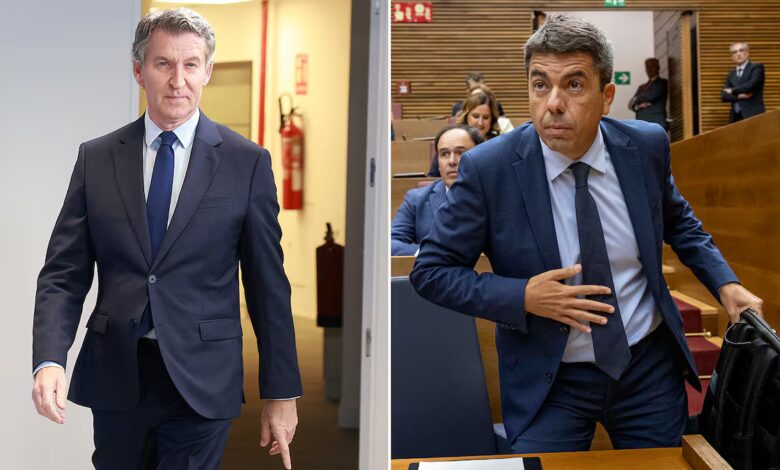
The evening of October 29, 2024, will be long remembered in Valencia. On this day, the region was gripped by a devastating dana that claimed 230 lives. At the height of the catastrophe, an intense exchange unfolded between Alberto Núñez Feijóo, leader of the Partido Popular, and Carlos Mazón, then head of the Valencian Community. These messages have now been handed over to the court investigating the authorities’ response that night.
A judge from Catarroja requested the complete correspondence between Feijóo and Mazón to understand how decisions were made and who was actually in control. Feijóo didn’t hesitate to provide notarized copies of the messages, which are now under close scrutiny.
Chronicle of the Correspondence
At 20:08, Mazón briefly thanks Feijóo. A minute later, he writes, “I’ll explain later. The situation is getting worse by the minute.” At 20:11, the ES-Alert alarm sounds across the province. At 20:15, Mazón admits, “A long night lies ahead.”
Feijóo replies 11 minutes later, “Hang in there. Take the lead in information, like you did during the fire.” At 21:29, he apologizes for the delay—he’s at an event, but promises to call back. His questions are urgent: “Casualties? Missing persons? Extensive damage?”
In response, Mazón says he tried to reach Pallete, head of Telefónica, via mobile since it was impossible to work without communication. He had already spoken to him directly. At 21:45, Mazón admits, “We’re not coping, we don’t understand what’s happening, dozens of reports about missing people are coming in, but I can’t confirm anything.”
A Night of Crisis
Feijóo quickly forwards Palete’s contact. At 23:21 he asks if the government has called and if enough help has arrived. Mazón replies evasively: “More or less, yes.” But then adds: “They’ve set up a crisis team, which is useless. Just an empty formality.”
Feijóo clarifies when exactly the call came and which minister is coordinating. Mazón lists: he spoke with Sánchez, Montero, as well as with defense and interior representatives. All forces are on high alert. But the main problem is the inability to reach several towns, where people are being forced onto rooftops seeking rescue.
Feijóo asks when the disaster will end. Mazón estimates: “Not before three in the morning.” He notes that for now, the key role belongs to the military (UME), and everything needed is in place. Still, the night threatens to be endless.
Losses and Despair
A worrying detail emerges in the correspondence: “There are already fatalities in Utiel, and there will be more. This is a disaster, President. There will be dozens of deaths, for sure,” Mazón writes. Feijóo once again offers his help and is ready to come to the scene at any moment.
At 23:27, Feijóo advises: “Work through provincial councils, keep people informed, provide updates yourself.” The message reflects an attempt to control the information flow and prevent panic from overwhelming the region.
Politics and Emotions
The entire correspondence is filled with anxiety and a sense of complete confusion. Mazón openly admits that the authorities do not grasp the scale of the disaster, and information arrives chaotically. Feijóo, despite the distance, tries to support his colleague and guide him, emphasizing the importance of communication and personal leadership.
At a certain point, it becomes clear that even at the highest level, no one was prepared for such a turn of events. Decisions were made on the fly, and coordination between different agencies left much to be desired. Yet it is in such moments that the true nature of power is revealed—not in offices, but in brief, sometimes desperate, messages sent in the middle of the night.