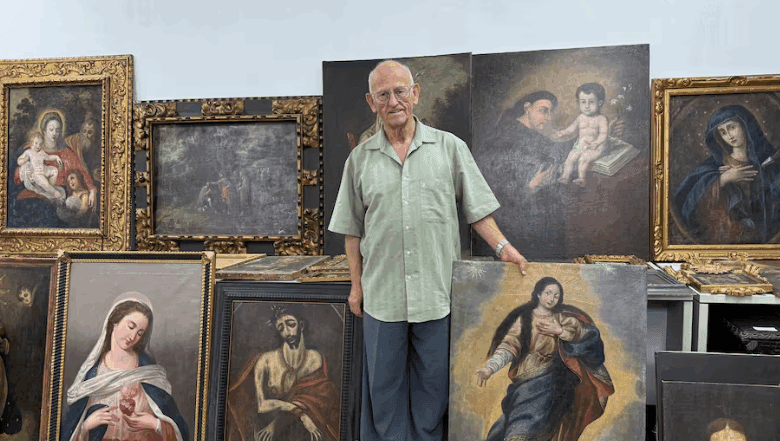
In the tiny town of Lagunaseca, nestled among the hills of the Cuenca province, an unusual collection of artworks is kept in the basement of the town hall. It was gathered and restored by Mariano Vélez, a retired priest who now dreams of giving his village a new cultural center. Over the years, through both work and passion, he has amassed more than a hundred paintings, sculptures, and ecclesiastical items, many of which were literally rescued from the street or bought at flea markets in Madrid.
Vélez’s interest in restoration began in his youth, when he served in one of the parishes near Madrid. He was inspired by efforts to restore old frescoes and decided to train at a workshop run by the archbishopric. Since then, his life has been divided between ministry and art. His collection includes both religious themes and secular paintings, as well as antique furniture—sometimes even items that friends found near garbage bins.
The collection’s standout pieces are the large canvases, some of which, according to Vélez, could grace any museum. Among them are works believed to be linked to Italian masters, as well as paintings reminiscent of Caravaggio’s style. For the collector himself, however, authorship matters less than the story and emotions behind each piece. He often admits he’s not after big names, but chooses what speaks to the soul.
A dream of a museum—and the challenges of a small town
Today, all these works are carefully stored in a small room beneath the administration building. Vélez is convinced that a museum could become a new symbol of Lagunaseca, attract travelers, and breathe new life into the dying village. The town already boasts natural attractions like the famous torcas—huge sinkholes—and an old church with a carved ceiling. But, according to the pensioner, it is art that can truly unite the past and future of this place.
To bring his idea to life, Vélez has already secured the support of local authorities and even drafted a proposal for the future museum. An architect estimated the necessary work at around 200,000 euros—a sum far beyond the means of a municipality where only about twenty people stay through the winter. Despite the enthusiasm, the city budget can’t accommodate such an ambitious plan without outside help. Now, the former priest is hoping for support from regional authorities or private patrons who might invest in the cultural development of the province.
A collection that could change the fate of Lagunaseca
For now, the unique collection continues to wait for its moment in the basement. Vélez remains hopeful that one day his dream will come true, and the works he invested so much time and effort in will become accessible to everyone. He is convinced that even a small exhibition can draw attention to this forgotten corner of Cuenca and breathe new life into it. For Mariano Vélez himself, it’s not just about personal legacy, but also a chance to preserve cultural memory for future generations.