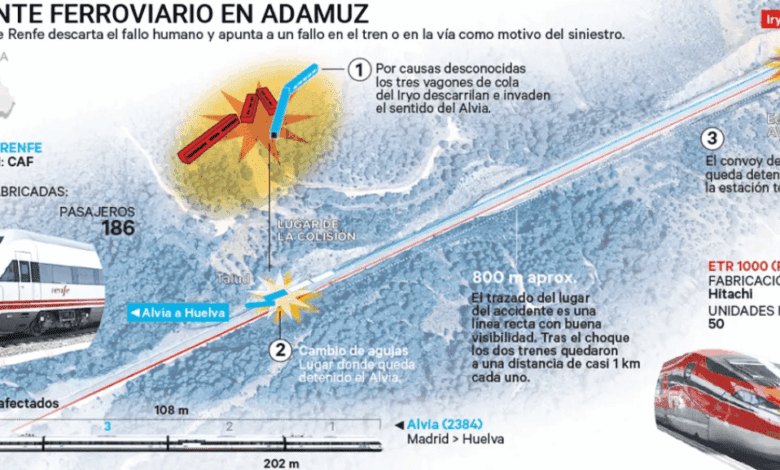
The rail tragedy in Adamuz has shocked all of Spain. Dozens dead, mangled train cars, and questions that remain unanswered. Engineers investigating the incident point to two main theories: either a critical failure occurred on the stretch of track, or a serious technical malfunction happened aboard the train itself. Human error or speeding were ruled out immediately—modern safety systems simply do not allow for such mistakes.
Renfe chief Álvaro Fernández Heredia stated explicitly: human factors could not have caused this tragedy. Even though the LZB system on this stretch is less advanced than ERMTS, it still provides a high level of control. According to him, the automated systems would have prevented any speeding or other critical errors on the part of personnel.
Seconds before disaster
Experts note that even if the system had worked flawlessly, there was no time to prevent the collision. The Iryo train derailed, and just 20 seconds later, an Alvia train sped by at high speed on the opposite track. Bringing a train to a complete stop at 200 km/h takes at least a minute—making it impossible in such a short window. In this situation, no warning system could have averted the outcome.
President of the Council of Engineers César Franco highlights that the accident occurred on a straight section of track that had recently undergone major repairs. The Iryo train had just passed a technical inspection. All of this makes the incident even more mysterious. Transport Minister Óscar Puente described the circumstances as ‘strange’—and it’s hard to disagree.
Technical details
Specialists are focusing on the details: analyzing the condition of the wheelsets, suspension, and the rails themselves. According to engineers, trains undergo inspections as rigorous as those in aviation. Every component—from wheels to rails—must meet the highest standards. Yet even with such strict controls, hidden defects that aren’t detected during standard checks are still possible.
Engineer Ramiro Aurín points out that the first five carriages passed the problematic section without incident. This may indicate that the rails were in proper condition—at least up to a certain point. However, a sudden metal fracture or microcracks, which could have revealed themselves specifically when the sixth carriage passed, cannot be ruled out. Especially considering that the steel used in infrastructure sometimes fails due to manufacturing defects.
The mystery of the sixth carriage
The theory that the sixth car was the starting point of the disaster is becoming increasingly likely. The problem may have been in its running gear—for example, a fault in the bogie or suspension. It is also possible that the rail itself fractured at that moment, triggering a sharp lateral impact and subsequent derailment. Engineers note that even the slightest defect at the wheel-rail contact zone can lead to tragedy at high speed.
Reports from train drivers, who previously noticed strange noises on this stretch, add further intrigue. This could point to a micro-defect that was slowly compromising the metal under load. At some point the material gave way, causing a break that led to the catastrophe.
Critical points
Particular attention is being paid to the track switch—a component always considered a vulnerable part of railway infrastructure. The derailment occurred in the area of the switch. Specialists are now meticulously examining every detail, photographing each component to reconstruct the sequence of events. It is possible that the key to the mystery lies right here.
Investigators have at their disposal the so-called train ‘black boxes’ that record all movement parameters and system operations. Decoding this data may provide answers to questions that remain unresolved for now. But it is already clear: the tragedy in Adamuz was the result of a series of subtle yet fatal coincidences, not negligence or human error.