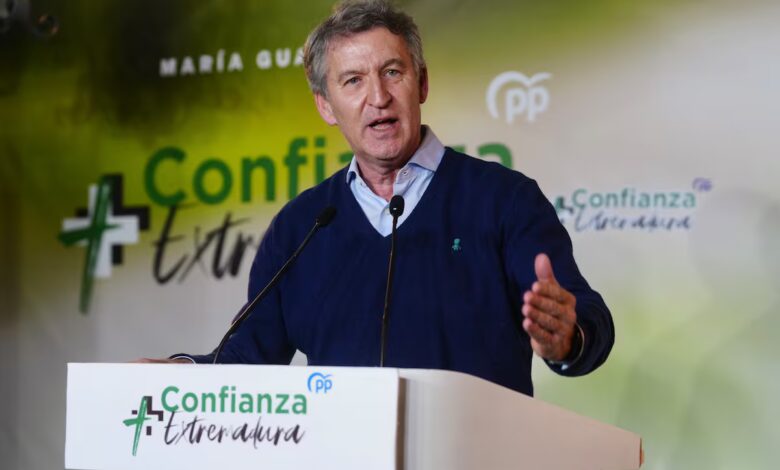
Ahead of the elections in Extremadura, the leader of the Partido Popular (PP), Alberto Núñez Feijóo, has openly admitted that securing an absolute majority in the region is highly unlikely. Speaking to voters in Zahínos (Badajoz), he noted that the current political climate does not allow PP to form a government on its own. According to him, the party will again have to turn to Vox for support, despite the fact that disagreements with this political force previously led to early elections.
Feijóo emphasized that achieving a majority in today’s Spain is becoming increasingly difficult. His strategy is to win more votes than the left-wing parties in order to minimize Vox’s influence in a potential coalition. However, the politician believes that it will be Santiago Abascal’s party that sets the terms for cooperation. Feijóo called on Vox not to block the regional parliament’s work by joining forces with the left.
Electoral realities
Within the PP, there is no secret: even with a high percentage of votes, an absolute majority remains out of reach. They recall that in 2011, José Antonio Monago, who then led the party in Extremadura, was unable to secure the required number of seats even with 46% of the vote and had to seek a compromise with the left. Now, by all accounts, the current regional head, María Guardiola, is not reaching those numbers, and Vox’s growing popularity is only making the task more difficult.
The latest polls indicate that the PP can expect about 38.8% of the vote, which would give them 30 seats in parliament — three short of an outright majority. Vox, according to forecasts, is set to increase its representation to 9 deputies, with around 14% of the vote. The left-wing parties, meanwhile, are losing ground: PSOE risks securing just 21 seats, while Unidas por Extremadura may get 5.
PP’s Strategy
Feijóo makes no secret of the fact that his main goal is not an absolute majority, but to lower the “price” of Vox’s support. To achieve this, the PP aims to outpace the left in terms of votes, making it sufficient for Vox to simply abstain rather than offer active support to form a government. Within the party, there is confidence that Vox will eventually soften its demands, although representatives of the far-right have already stated they expect better terms than those in Valencia.
The question of how high a price Vox will set for its support remains unresolved. The PP hopes negotiations will not drag on and the region will avoid another political deadlock. However, Vox representatives have indicated they do not intend to make concessions without guarantees.
Intraparty Debates
During his speech, Feijóo also commented on the remarks by the president of Madrid (Isabel Díaz Ayuso), who urged the party to be more passionate and decisive. The PP leader joked that he does not consider himself a “lukewarm” politician and has no desire to join the ranks of the indecisive. He reminded the audience that he has always won every election he has participated in and stressed that opinions on his style differ: some consider him too tough, others — on the contrary, not assertive enough.
Internal party debates persist over election strategy and how to manage relations with Vox. Some advocate for a hardline approach, while others suggest seeking compromises to ensure regional stability.
Coalition prospects
It appears that the PP in Extremadura will not be able to avoid negotiations with Vox. Despite attempts to minimize the influence of the far right, their support will be key to forming a new government. The question remains under what terms an agreement will be reached and how it will impact the region’s political balance.
For now, voters are preparing for the decisive vote, while parties brace for tough negotiations that will shape Extremadura’s future in the coming years.