In the very heart of the Aragonese Pyrenees, nestled in the picturesque Tena Valley, lies a place with an extraordinary story. Lanuza is more than just another beautiful mountain village. It is a symbol of unbreakable human spirit, a settlement once destined to disappear underwater that rose from oblivion to become one of the region’s most captivating tourist destinations. Its history, which began nearly half a century ago with the tragedy of forced eviction, has today become a legend of revival.
From oblivion to new life
The late 1970s marked a turning point for Lanuza. An ambitious dam project on the Gállego River demanded sacrifices, and the centuries-old village paid the price. Residents were ordered to leave their homes, their land, their entire lives. In 1978, the last inhabitant left, and soon after, the waters of the new reservoir submerged orchards, fields, and lower streets. What remained above water was looted and gradually crumbled under the pressure of time and the elements. It seemed the story of Lanuza had come to an end. But decades later, former residents and their descendants, unwilling to accept the loss, decided to defy fate. In the late 1990s, a unique restoration process began. With little government support and driven purely by determination, people started to rebuild their ancestral homes, carefully preserving the authentic architecture with its stone, slate, and noble wood.
A turning point came with the creation of the international festival Pirineos Sur. This cultural event breathed new life into the village, attracted global attention, and turned the floating stage on the reservoir into one of the most recognizable symbols of the Spanish summer. This year, for example, from July 10 to 27, performances by stars such as Amaia, Zaz, Natalia Peluso, and Ara Malikian are expected here.
A walk through streets reclaimed from the water
Today’s Lanuza is a place where every stone tells a story of struggle and love for the land. A stroll along its impeccably restored streets brings a sense of peace and harmony. From any point, breathtaking views open onto the turquoise surface of the reservoir and the majestic peak of Peña Foratata, especially at sunset, when the sun bathes the slate roofs in golden hues. At the heart of the architectural ensemble is the Church of the Savior, built in the 19th century on Romanesque foundations. Inside, it houses a precious relic—a silver reliquary from 1557 containing the remains of Saint Quiteria. Nearby is the main square, where the traditional dance Palotiaú has been revived. Also attracting attention are the old stone fountains, observation decks, and the conical chimneys typical of Upper Aragón, crowning the rooftops of houses adorned with flowers on their balconies.
But the main modern attraction is, of course, the floating amphitheater. Even outside the festival season, it makes a lasting impression, serving as a magical place to admire the surrounding landscape and reflect on the incredible journey this village has taken.
What to do around Lanusea
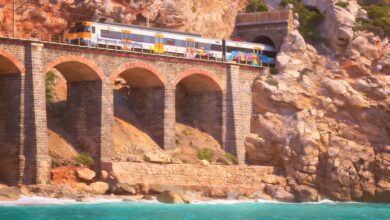
Lanusea and its surroundings offer plenty of options for active and family recreation. Hiking enthusiasts can enjoy panoramic trails, such as the path to the Sierra-Plana viewpoint, which offers stunning views over the entire valley. In summer, the reservoir becomes the main draw for water sports lovers: here you can go kayaking, paddleboarding, or simply swim in the pristine water at specially equipped areas. In winter, the region turns into a paradise for skiers. Its proximity to the major ski resorts Panticosa and Formigal provides access to slopes of all levels of difficulty, as well as activities like sledding and snowshoeing. For a more relaxed way to explore the area, take a ride on the Tena Valley tourist train, while families with children will enjoy a visit to the Lacuniacha wildlife park, where you can see wild animals in their natural habitat.
The taste of the Pyrenees and the road to wonder
A trip to Lanusa wouldn’t be complete without experiencing the local gastronomy. The cuisine here is based on traditional recipes and high-quality mountain ingredients. Be sure to try migas (breadcrumbs with egg and grapes), chiretas (stuffed lamb offal), tender roast lamb (ternasco), and hearty soups. Trout from the Gállego River, either baked or served with jamón, is also a local delicacy. For dessert, enjoy empanadicos with pumpkin or apple, and aniseed pastries. Local cheeses, sausages, and seasonal mushrooms round out the picture of an authentic cuisine born in harsh conditions but perfected over generations. Reaching this revitalized wonder is easy. From Huesca, it’s about an hour’s drive (85 km) along the A-136 towards Sallent de Gállego. Zaragoza is 152 km away, and from Barcelona or Madrid it’s about 350-380 km. The nearest train station is in Canfranc, but most visitors prefer to use personal vehicles or take buses to Sabiñánigo with a subsequent transfer.