The restoration of rare historic sites always draws attention, but when it comes to royal vessels, the significance of the event goes far beyond ordinary conservation. For Spaniards, the reopening of the renovated museum in Aranjuez is an opportunity to connect with an era when luxury and power were displayed not only on land but also on the water. For years, the museum remained hidden from popular tourist routes, but it is once again open to visitors and ready to impress even those who consider themselves experts on the country’s heritage.
Nestled in the shadows of the lush Prince’s Garden (Jardín del Príncipe), on the banks of the Tajo River, stands a pavilion that may appear unremarkable from the outside. Step inside, however, and you’ll find a true treasure trove: six unique vessels once belonging to Spanish monarchs. After nine months of meticulous restoration, these boats are revealed to the public in all their former glory. There are no queues or tourist crowds here, and the atmosphere transports you back in time when royal barges glided along the water to the sounds of music and applause from the court.
Royal Vessels
The museum’s collection is considered one of the most unusual in Europe. Among the exhibits are not only the famous golden gondola commissioned by Charles II in Naples, but also boats gifted to Spanish monarchs by cities and regions across the country. Each vessel is more than just a means of transport—it is a symbol of an era when water parades and festivities were an integral part of court life. In the 17th–19th centuries, these boats sailed the waters of the Retiro, San Ildefonso ponds, and the Tagus itself, accompanied by orchestras and theatrical performances.
The restoration process involved not only cleaning and strengthening the structures, but also the reconstruction of lost decorative elements: carvings, gilding, and polychrome finishes. Artisans of various specialties worked on the project—from carpenters to gold and textile artists. All work was carried out with the utmost respect for the original materials, using reversible techniques to preserve the authenticity of each exhibit.
The Golden Gondola
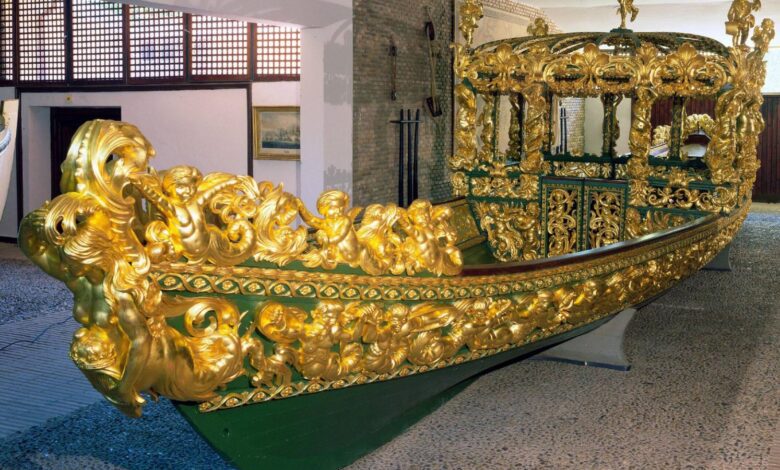
A special place in the exhibition belongs to the gondola of Charles II—the oldest and most luxurious of all presented. It stretches over 16 meters long, its hull adorned with figures of sirens, tritons, and a winged lion, all covered in gold leaf. Originally, the vessel was intended for outings on the Grand Pond of Retiro, but in the 20th century it was transported to Aranjuez. The chief gold restorer notes that despite previous interventions, the gondola remains the jewel of the collection.
Next to it, you can see Charles IV’s felucca adorned with coats of arms painted in oil, a Pompeii-style boat belonging to Maria Christina Bourbon, as well as a canoe built in Ferrol in 1859, and a felucca from Mahón, gifted to Isabella II. Each vessel has its own story, closely tied to royal celebrations, diplomatic gestures, and the personal tastes of the monarchs.
The museum’s future
The current restoration is only the first phase of a large-scale renovation. In the coming years, construction will begin on a new building for the museum, which is set to open its doors to visitors in 2028. The new pavilion will be more spacious and modern, with vessels displayed so that they can be viewed from different angles, including against the backdrop of the Tagus River. The plan includes the use of advanced multimedia technologies to immerse visitors more deeply in the historical context.
For now, residents and visitors in Madrid have a unique opportunity to see these vessels in the familiar, intimate setting of the old pavilion. The museum remains one of the few places where you can sense the spirit of bygone eras and imagine what royal festivities on the water were like.
Context and examples
In recent years, Spain has seen a growing number of projects aimed at restoring forgotten monuments and museums linked to royal history. For example, the restoration of royal carriages in Madrid was recently completed, and in Segovia, a renovated pavilion housing the Bourbons’ collection of hunting trophies has been opened to the public. Such initiatives not only breathe new life into unique sites but also boost domestic tourism, offering new routes for those seeking unusual experiences. The restoration of the museum in Aranjuez is another step towards preserving and promoting Spain’s rich cultural heritage.