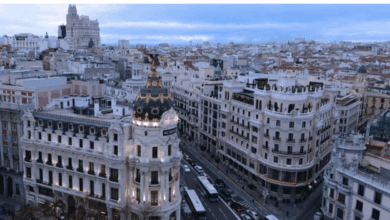
A dispute is heating up in Madrid over the fate of one of the city’s last historic estates. Plans to develop the area, where hundreds of almond trees stand, could result in the disappearance of a unique spot combining nature and history. For local residents, this is more than just an architectural issue — it’s about preserving a piece of cultural heritage and green space, which is becoming increasingly rare in the capital.
A project accepted by the city council for review in 2024 would replace the 18th-century estate and its adjacent plots with office buildings. The land is owned by the religious group Madres Adoratrices, the French company Therus Investment SL, and the municipality. According to El Pais, the initiative has sparked a wave of discontent among locals and activists, who have already collected more than 6,000 signatures calling for the site’s preservation. The association Salvar Hortaleza is organizing new gatherings to draw attention to the issue and push for protection of the estate.
Historic significance
The Huerta de Mena estate holds a special place in the district’s history. The first records date back to the 18th century when the land belonged to Eugenio de Mena. In the late 19th century, the estate passed to Rafael Gasset Chinchilla, and later to the renowned playwright Carlos Arniches. During that era, the estate became a cultural hub frequented by members of the intellectual elite, including the poet Rafael Alberti. It was here, according to El Pais, that many poems from the collection “Sobre los ángeles” were written.
The change of ownership did not alter the essence—the estate remained a place where rural tradition intersected with urban culture. Architect Concha Diez-Pardo and archaeologist Rosa Domínguez conducted a study confirming the site’s historical significance. They note that the estate reflects the character of Madrid’s suburban farms of the 18th and 19th centuries, and its disappearance would be an irreparable loss for the city.
Environmental risks
Beyond its cultural value, the estate is important for the area’s ecology. The 36,000-square-meter property is home to more than 200 trees, including almond, elm, and tree of heaven. Activists fear that the project will lead to mass deforestation and the loss of a green space that could become a new park for residents. Despite promises to preserve some plantings, the public doubts that the trees will remain in the final version of the project.
In February 2025, the Salvar Hortaleza association officially submitted a petition with signatures to the regional Ministry of Culture. Madrid authorities are considering recognizing the estate as a cultural heritage site, but the decision has been delayed. According to administration officials, additional studies of the building’s architectural and archaeological features are underway.
Political disagreements
The issue of protecting the Huerta de Mena estate has become a subject of political debate. In February 2025, Partido Popular deputies rejected the Más Madrid proposal for full protection of the area, despite support from Vox and PSOE. Earlier, a technical report commissioned by the Madrid government recommended designating the estate as a heritage monument, but these recommendations were not implemented. As a result, protection only applies to specific elements—the main building and the garden—while the rest of the estate remains at risk of development.
The Madrid municipality also declined the initiative to include the estate in the heritage register, citing the compatibility of the new plan with potential protection. This position creates uncertainty and offers no guarantees for preserving the historic complex. Architects and researchers emphasize that losing the estate would be a blow to the city’s historical memory and would deprive the neighborhood of a unique green space.
In recent years, Spain has repeatedly seen disputes over the preservation of historic sites threatened by new construction projects. In Valencia and Barcelona, local residents have also protested against the demolition of historic buildings for commercial development. Such conflicts often spark public campaigns and urban planning reviews, though they do not always end in favor of heritage preservation. The challenge of balancing city growth and the protection of cultural assets remains relevant for many regions across the country.