In early 17th-century Salamanca, the name Susana Muñoz hardly stood out. Yet she, unable to read or write, rose to head the largest printing house of her era and left a lasting mark on the history of Spanish music. Her life was a succession of marriages to master printers, widowhood, and an independent struggle to secure her place in a male-dominated world.
Muñoz married three times, each time to a professional printer. After each husband’s death, not only did she persevere, but she also took over the business, signing books as ‘widow of so-and-so.’ Her name appears on dozens of publications, and today researchers are confident: she was the driving force behind the monopoly on publishing church music in Spain at that time.
Musical legacy
Thanks to Muñoz’s work, the compositions of Sebastián de Vivanco and Juan Esquivel de Barahona have survived to this day. Twenty-four copies of her publications are preserved across archives in Spain, the United States, Mexico, Poland, and Portugal. In Portugal, a unique contract was discovered for the printing of a collection by the little-known composer Diego de Bruceña, in which Muñoz pledged to complete the job in 75 days, taking responsibility for the paper, musical typefaces, and proofreading.
Research shows that in the early decades of the 17th century, seven massive choir books were produced by her printing house, each requiring hundreds of pages of musical notation. This was a complex and expensive process, demanding special materials and expertise. Print runs were small—roughly matching the number of cathedrals in Spain—which underscores her monopoly in the market.
A Family Enterprise
Muñoz’s first husband, Artus Tavernier, arrived in Salamanca from Antwerp around 1580. They had five children, the youngest of whom, Jacinto Tavernier, would later become the official printer for the University of Salamanca. After her first husband’s death, Muñoz continued the business and later married Francisco de Cea Tesa, whose name also appeared on title pages.
A third marriage to Antonio Vázquez further strengthened her position in the printing world. Vázquez subsequently became the official printer to the University of Alcalá de Henares. The Muñoz family business laid the foundation for a dynasty that continued her legacy after her passing.
A Path to Independence
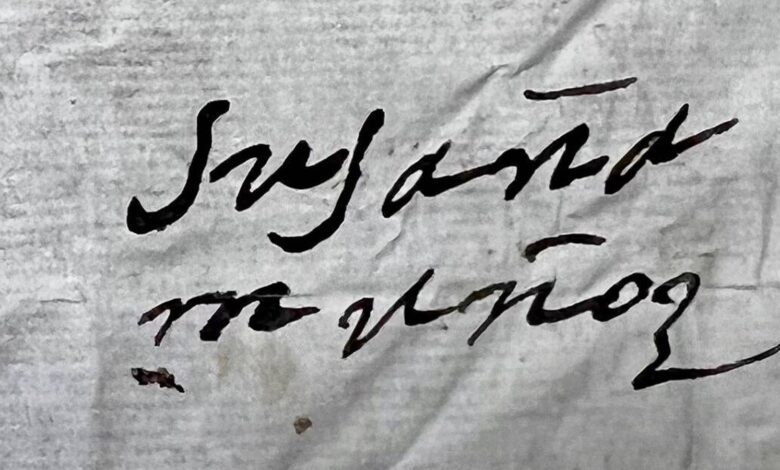
When Muñoz first took charge of the print shop, she could barely write. She quickly mastered the intricacies of the business: signing contracts, negotiating with authors and booksellers, overseeing quality. Surviving documents show how her signature grew more confident over time—a testament to her personal development and determination.
From 1607 to 1625, her printing press published around 120 books on a wide range of topics: medicine, law, literature, history, poetry, and, of course, music. Especially popular was Francisco de Montanos’s treatise “El arte de canto llano” (The Art of Plainchant), with a print run reaching 3,000 copies—a record for that era.
A Woman in the Shadows
Despite the scale of her contributions, Muñoz’s name long remained in the shadow of husbands and sons. She was listed alongside men in contracts, but history has preserved neither her portrait nor details of her personal life. Her role in preserving Spain’s musical heritage only became clear centuries later.
Thanks to her efforts, we have almost complete collections of works by three early Baroque composers—2,800 pages of sheet music that are essential to understanding the golden age of Spanish music.
Modern Recognition
In November 2025, new information about Muñoz’s life and work was presented at the opening of the Spanish and American Music Research Group in Madrid. The project, which brings together leading experts from Spain and the United States, aims to study and promote forgotten names in music history. In the near future, a modern edition of one of the rare collections printed by Muñoz in Portugal is scheduled for release.
The story of Susana Muñoz is an example of how a woman, despite all obstacles, managed not only to survive but to become a key figure in the cultural development of her country.