The story of Ebro is more than just the tale of an automotive brand—it’s a real-life drama of Spanish industry, marked by soaring highs, sharp declines, and an unexpected comeback from obscurity. In the mid-20th century, Ebro became a symbol of reliability for farmers and entrepreneurs, but after decades, it vanished from the country’s roads. Today, thanks to global transformation and new partners, car enthusiasts are once again talking about the Ebro brand.
It all began in 1954, when Motor Ibérica, S.A. founded Ebro following the nationalization of Ford’s Spanish subsidiary. From day one, the brand focused on producing trucks, vans, SUVs, and agricultural machinery. Thanks to these vehicles, Ebro quickly earned the respect of professionals, and its products became an integral part of Spanish roads and fields.
Motor Ibérica’s headquarters were located in Barcelona, where since 1923 the company had been hard at work developing machinery for a range of needs. Over several decades, Ebro became one of the country’s leading industrial brands. The F/Trade van series, later produced as the Nissan Trade, was especially popular. However, despite its success in the commercial market, Ebro’s passenger cars never managed to win over the mainstream buyer.
The Lost Years
Gradually, Ebro’s position began to weaken. By the 1980s, the company faced tough competition and internal challenges. Production declined, and interest in the brand faded. As a result, in 1987, new vehicle production under this name was completely discontinued. The factories and assets of Motor Ibérica were acquired by other market players, and the Barcelona plant soon came under the control of Nissan.
The Japanese automotive giant used Ebro’s former facilities to manufacture its own models, such as the Navara and NV200. But this era also came to an end—in 2021, production at the plant was halted. It seemed that Ebro’s story was finally over, leaving behind only memories and old emblems on vintage vehicles.
A new lease on life
However, fate had an unexpected twist in store. In 2023, the Ebro name returned to the Spanish market. By then, more than thirty years had passed since the brand had disappeared, and few believed in its revival. Everything changed thanks to a partnership between the Spanish company EV Motors and the Chinese automotive group Chery. Together, they breathed new life into the classic brand with cutting-edge technology, investment, and manufacturing expertise.
The relaunch was based at the iconic Zona Franca in Barcelona—the very site where Ebro and Nissan once operated. The new plant, named Ebro Factory, became a symbol of the region’s industrial revival. Its opening directly created over a thousand jobs, with several thousand more indirectly, providing a significant boost to the local economy.
Modern lineup
The first mass-produced vehicle of the new Ebro era rolled off the assembly line at the end of 2024, a milestone that created a real sensation in Spain’s automotive industry. Initially, assembly relied on components imported from China, but in the coming years, the company plans to establish a full-cycle manufacturing process locally.
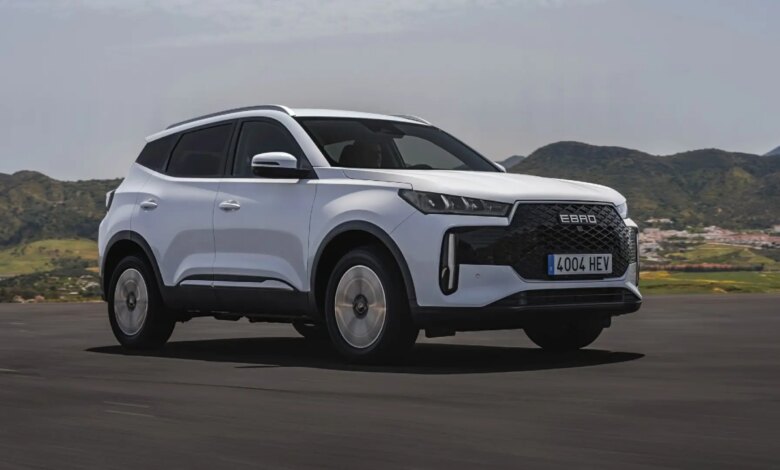
Ebro quickly expanded its range. Today, the brand offers crossovers and SUVs for various customer segments. The lineup includes traditional gasoline, hybrid, and fully electric models. The S400, S700, S800, and S900 are all built on Chery platforms but are adapted to meet European standards and preferences.
The compact S400 is designed for city dwellers. With a length of 4.35 meters, its trunk holds 380 liters, and under the hood is a 211 hp hybrid system with a fuel consumption of 5.3 liters per 100 km. It’s the most affordable model in the lineup, but not the first introduced.
Technology and ambition
The S700 and S800 are midsize SUVs with nearly identical technical specifications. The base version is equipped with a 1.6 TGDI gasoline engine producing 147 hp. For those prioritizing sustainability and efficiency, there is a plug-in hybrid variant combining a 1.5 TGDI gasoline engine (140 hp) with a 201 hp electric motor and an 18.3 kWh battery, providing an electric-only range of over 90 km. Fast charging can replenish the battery from 30% to 80% in just 19 minutes.
The flagship S900 is on a whole different level. With a length of nearly 4.8 meters, it features a hybrid system combining three electric motors and a gasoline engine, delivering a total output of 425 hp. The 34.46 kWh battery guarantees up to 140 km of electric range, while the total range exceeds 1,400 km. Fuel consumption in the combined cycle is just 1.68 liters per 100 km, a figure impressive even for the most demanding skeptics.
A focus on modern technology and hybrid solutions has allowed Ebro to carve out its niche in the market quickly. The brand emphasizes safety, comfort, and environmental responsibility—qualities especially valued by European consumers.
If you didn’t know, Ebro is a Spanish car brand founded in 1954 by Motor Ibérica. Over the years, the brand specialized in commercial vehicles, agricultural machinery, and SUVs. After a long hiatus, Ebro was revived in 2023 thanks to a partnership between EV Motors and the Chinese company Chery. Today, the company produces modern SUVs and hybrid vehicles, and its Barcelona factory has become a symbol of Spain’s industrial renewal.