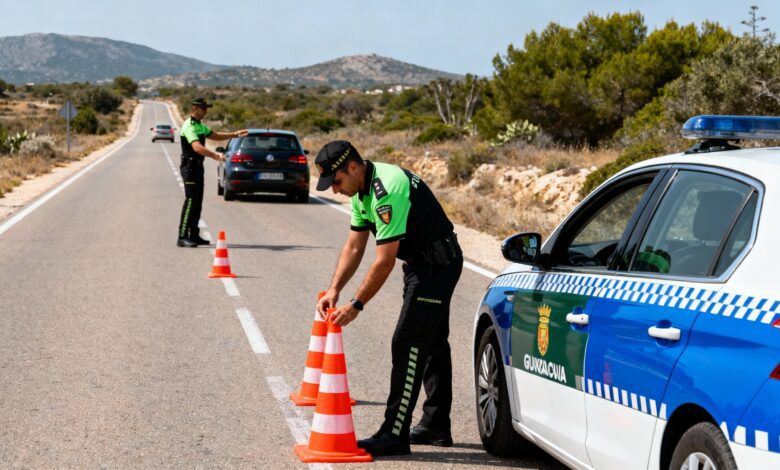
Last Sunday, a scandal erupted on Ibiza that is unlikely to leave even the calmest drivers indifferent. What began as a routine journey on the EI200 highway for two women took an unexpected turn: after being stopped at a standard police checkpoint, one of them decided to warn other drivers about the location of the inspection by sending a message to a popular Telegram chat. Seemingly a harmless act of solidarity, but the consequences turned out to be much more serious than one might expect.
Police quickly noticed a sharp drop in traffic on that stretch of road, with some drivers even choosing to detour around the checkpoint altogether. This raised suspicions among members of the Instituto Armado, who launched their own investigation. They soon discovered that the exact location of their post—at a roundabout near Santa Eulària—had been shared in a Telegram group. It didn’t take long to identify the author of the message: it was one of the women they had just stopped at that very checkpoint.
Ban on disclosure
Officers from the Guardia Civil reminded the public that posting information about police operations is not just a harmless prank. The law expressly prohibits sharing details about the location or activities of security forces if it could interfere with their work. In this case, Article 36.23 of Organic Law 4/2015 is in effect, protecting public safety. Breaking this rule can result in a fine ranging from €601 to €30,000—a sum that could unsettle even the most carefree individuals.
Authorities emphasize that such actions not only hinder police work but also pose a threat to all road users. When drivers are warned about checkpoints in advance, they can evade accountability for driving under the influence, using drugs, or lacking required documents. This isn’t just a matter of discipline – it’s a matter of life and death on the roads.
Technology versus the law
The situation in Ibiza is not isolated. In recent years, Spain has seen a surge of chat groups and apps where drivers share information about road checks, cameras, and even weather conditions. At first, these groups seemed useful—people would alert each other to traffic jams, accidents, or hazardous areas. But over time, the focus has shifted: now, the main goal of many such communities is to help members avoid fines and liability.
Previously, drivers used light signals to warn each other about police traps. Now, technology lets them instantly alert hundreds or even thousands of people at once. This presents a whole new level of challenge for law enforcement, which is forced to adapt to the demands of the digital age.
Officials respond
The Directorate General of Traffic (Dirección General de Tráfico, DGT) has repeatedly warned: using social networks and messaging apps to share information about police operations is a direct violation of the law. The agency points out that such actions undermine trust in the control system and jeopardize road safety.
Authorities are openly frustrated: while such cases used to be rare, they have now become widespread. The problem is especially acute on the islands, where information spreads instantly and there are few alternative routes. As a result, even a single post can completely undermine police efforts to maintain order.
The limits of what is acceptable
The story of the Ibiza resident is a vivid example of how fine the line is between wanting to help others and breaking the law. On the one hand, many see warning about checks as an act of mutual support. On the other, such actions can have tragic consequences if a drunk or dangerous driver manages to avoid police control.
Personally, I believe that in the digital age, responsibility for our actions has only grown. Anyone who shares this kind of information should realize: it might bring likes and thanks, but also very real fines. Perhaps stories like this will make some think twice before treating the internet as a consequence-free zone.