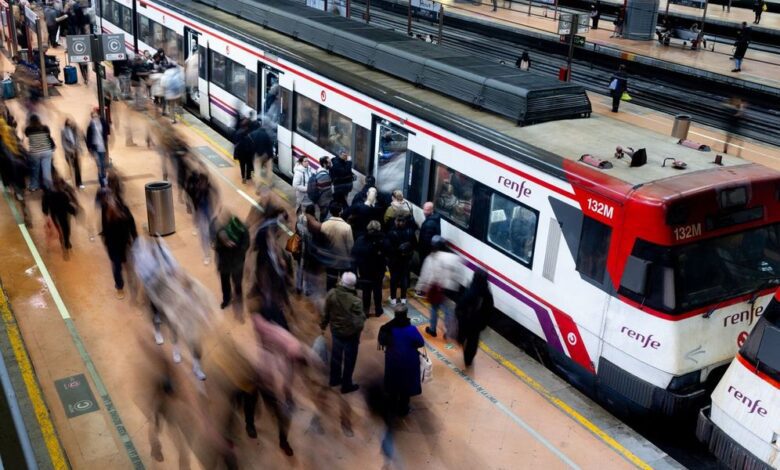
In the Madrid region, thousands of residents have faced unexpected challenges as Renfe has changed the schedules for commuter trains on lines C-2, C-7, and C-8 due to the aftermath of strong winds. This decision has affected people who rely on train transport for their daily commute. The reason is damage to the roof of a key depot in the Fuencarral area, where trains running on these routes are maintained. As a result, part of the fleet cannot undergo regular servicing, forcing the company to temporarily reduce the number of peak-hour departures.
Reasons for the changes
According to El Confidencial, a storm that hit the Madrid region last week damaged the roof of the train maintenance depot. Because of this, the facility had to be closed for repairs and clean-up, immediately affecting the ability to dispatch trains with the usual frequency. The changes are especially noticeable in the mornings, when thousands of passengers travel from the suburbs to the city center. Now, on the stretch from Alcalá de Henares, trains can be delayed by up to 15 minutes, whereas previously the interval was about 7 minutes. Toward Guadalajara, intervals have increased to 10–15 minutes instead of the previous 12.
At other times, according to Renfe, the schedule has remained virtually unchanged. During midday and evening hours, when passenger flow decreases, the intervals between trains remain the same. However, during morning and evening rush hours, when most residents are commuting to and from work, delays are felt most acutely. It is important to note that the express Civis train between Guadalajara and Madrid (Chamartín-Clara Campoamor) has been temporarily suspended; this service typically saves time thanks to fewer stops.
Impact on passengers
The schedule changes have affected not only Madrid residents but also those who commute from the suburbs daily. During peak hours, platforms are noticeably more crowded and waiting times have increased. For many, this means needing to leave home earlier or reconsidering their usual routes. Renfe advises checking the latest schedules on the official website or mobile app in advance to avoid unpleasant surprises. The company also recommends allowing extra travel time, especially in the morning.
On social media, users are actively discussing the situation, sharing photos of crowded platforms and complaining about the inconvenience. Renfe representatives assure the public they are doing everything possible to restore the regular timetable as soon as possible, but emphasize that schedule changes will remain in place until depot repairs are finished. Once the maintenance work is complete, the schedule is expected to return to its standard regime.
Context and similar cases
Disruptions in rail transport due to weather events are not uncommon in Spain. For example, recently in the south, high-speed train services between Málaga and Antequera were completely halted because of a sudden landslide, a situation examined in detail in the article about the sudden stoppage of train services in southern Spain. Such incidents highlight the vulnerability of Spain’s transport system to natural forces and how quickly even minor damage can affect the lives of thousands.
In recent years, Spain’s railway infrastructure has faced multiple challenges, whether from severe weather events or technical failures. In 2024, for instance, commuter trains in Catalonia stopped for several days after heavy rain, while in 2025, heat forced temporary restrictions on certain sections in Valencia. Each occurrence sparks new debates about the need to modernize and improve the resilience of the country’s transport system.