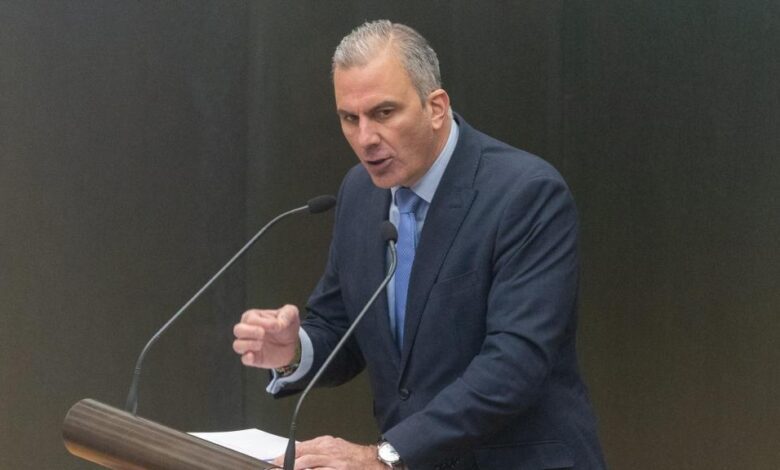
Internal disagreements within Vox have reached a new level after a sudden and rapid vote led to the resignation of one of the party’s most prominent figures. This development may impact the political dynamics in Madrid and spark debate about transparency and democracy within Spanish parties.
Javier Ortega Smith, until recently a member of the National Executive Committee (Comité Ejecutivo Nacional, CEN) and Vox’s official spokesperson in Madrid’s city council, sharply criticized the party leadership. In a letter addressed to his fellow committee members, he expressed outrage that his expulsion was approved almost unanimously and took less than two minutes. According to him, there was no discussion, and the decision was made “hastily and without the slightest dialogue.”
Accusations and repercussions
Ortega Smith claims that dissenting opinions have long been unwelcome within the party, and any attempts at discussion are suppressed. He described the CEN as a “decorative body” that has lost its role as a forum for debate and become merely an instrument for formally approving the leadership’s decisions. He says that manipulation, distortion of facts, and even personal attacks on social media were used against him to discredit and remove inconvenient members.
Despite the pressure, Ortega Smith announced his intention to remain with the party, to continue working as a member, and to retain his position as the official spokesperson for Vox in the Madrid City Council. He also stressed that he had no plans to leave the national parliament, where he holds a deputy seat.
Change chronology
Ortega Smith’s abrupt resignation marked the culmination of a series of steps to gradually remove him from key positions. In November, he was dismissed from his post as deputy party spokesperson in Congress, replaced by Carlos H. Quero. In January, he was stripped of his role as chair of the Justice Commission, which was handed over to Juan José Aizcorbe.
In recent months, Ortega Smith increasingly displayed disagreements with the party leadership. He attended public events shunned by other leaders and openly urged the party to listen to the voices of civil society. His participation in a memorial mass for the victims of the train disaster in Adamuz (Córdoba) became the final straw in a series of confrontations.
Internal divisions
Tensions within Vox are not limited to personal disagreements. Ortega Smith also criticized the party’s foreign policy direction, urging them not to blindly follow the example of Donald Trump, despite the party leadership’s strong support for the former U.S. president. His stance irritated top party officials, who favored a tougher and more unambiguous approach.
In his letter, Ortega Smith points out that his expulsion was the result of a targeted campaign to eliminate dissenters. He claims that the leadership uses slander and online pressure to undermine the reputation of those who disagree with the official stance.
Reaction and prospects
The scandal surrounding Ortega Smith’s resignation has sparked widespread debate among party members and observers. Many are questioning whether this conflict will further weaken Vox’s position in Madrid and at the national level. Some experts believe that such internal purges could intensify discontent within the party and trigger additional resignations.
It remains unclear how long Ortega Smith will be able to retain influence in the municipality and parliament. His determination to remain in politics may serve as an example for other dissatisfied members, as well as increase pressure on Vox leadership to demand greater openness and internal democracy.
In recent years, Spanish parties have faced increasing internal conflicts driven by power struggles and disagreements over key issues. Such situations have already led to high-profile resignations and reshuffles within other political forces in the country. Notably, in 2024, one of the leading parties experienced a split after several influential members were expelled, resulting in a significant drop in election support. In other cases, internal disagreements have led to the formation of new political movements and even the appearance of alternative factions in parliament. These events demonstrate that infighting within parties can have long-term consequences for Spain’s entire political system.